

Discover how Service Level Agreements (SLAs) define service expectations, uptime, response times, support responsibilities, security standards, performance metrics, escalation procedures, and long-term service quality.
Introduction
A successful business relationship should not depend on assumptions, informal promises, or unclear expectations. When a company relies on an external provider for website development, hosting, maintenance, IT support, cybersecurity, cloud infrastructure, or other technical services, both parties need to understand exactly what is expected. A Service Level Agreement (SLA) provides the framework for establishing those expectations in a measurable and transparent way.
A Service Level Agreement can define everything from service availability and technical support response times to maintenance schedules, incident priorities, security responsibilities, reporting procedures, escalation routes, and performance measurements. Instead of relying on phrases such as “fast support” or “reliable service,” an SLA converts expectations into specific commitments that can be monitored and reviewed.
For businesses, this clarity can make a significant difference. A website outage can affect leads, sales, customer confidence, and brand reputation. A slow technical response can allow a small issue to become a major operational problem. A security incident can create financial, legal, and reputational consequences. An effective SLA helps businesses establish procedures for handling these situations before they happen.
This comprehensive guide explains what Service Level Agreements are, how they work, what should be included, how service levels should be measured, how SLAs can support website and digital services, which mistakes should be avoided, and how businesses can build an SLA that supports long-term reliability.
The approach also considers Google’s broader recommendations for creating useful, trustworthy web experiences. Google’s Search Essentials provide guidance covering technical requirements, spam policies, and fundamental best practices for websites.
What Is a Service Level Agreement?
A Service Level Agreement is a formal agreement between a service provider and a customer that defines the expected level of service. It establishes measurable commitments concerning how a service should operate and how the provider should respond when something goes wrong.
An SLA can be used across many industries. Technology companies may use SLAs for hosting, cloud infrastructure, managed IT services, website maintenance, cybersecurity, software platforms, and technical support. Professional service providers can also use SLAs to define communication standards, delivery timelines, support availability, and escalation procedures. The exact contents depend on the service being provided and the customer’s business requirements.
The most important characteristic of an effective SLA is clarity. A statement such as “technical problems will be handled promptly” sounds positive but provides no objective measurement. What does promptly mean? Ten minutes? One hour? One business day? An SLA replaces that uncertainty with a defined target. For example, a particular incident priority could have a specified initial response target and a separate resolution objective.
This distinction is important because an SLA is not simply a document designed to make a provider appear professional. It should reflect the way the service is actually delivered. The provider should have the people, systems, monitoring, processes, and escalation procedures necessary to meet the commitments being offered.
For customers, this creates greater transparency. They can compare providers based on actual service commitments instead of marketing language. For providers, it establishes a structured framework for delivering support consistently and demonstrating performance.
A strong SLA can therefore become an operational foundation for accountability, predictability, communication, and continuous improvement.
Why Service Level Agreements Matter for Modern Businesses
Modern businesses increasingly depend on digital services. A website may generate leads, accept payments, provide customer information, support marketing campaigns, or serve as the primary communication channel between a company and its audience.
Because of this dependence, technical reliability is no longer simply an IT concern. It can directly affect revenue and customer experience.
Consider an online retailer whose website becomes unavailable during a busy sales period. Every minute of downtime can potentially prevent customers from completing purchases. Similarly, a professional services company experiencing a broken contact form may continue operating without realizing that prospective customers cannot submit enquiries.
An SLA helps organizations prepare for these situations by defining what should happen when a problem occurs. Instead of deciding during an emergency who should respond, which communication channel should be used, and how quickly action should begin, these procedures can already be established.
This is one of the greatest benefits of an SLA: it moves important decisions from the crisis stage to the planning stage.
An effective SLA can also improve supplier accountability. If a provider repeatedly misses agreed service targets, the customer has objective evidence that can be discussed during a service review. The conversation becomes based on documented performance rather than personal opinions.
This can be particularly valuable for organizations working with multiple suppliers. One provider may manage hosting, another may provide software, while an internal team manages content and marketing. Clearly defined responsibilities reduce the risk of an incident being passed from one party to another.
Service Level Agreements can also support better budgeting. When maintenance responsibilities, support services, emergency work, and service commitments are clearly documented, businesses can make more informed decisions about operational costs.
Ultimately, an SLA provides a shared understanding of what reliable service means.
SLA vs Service Contract, KPI, and OLA
The terms SLA, service contract, KPI, and OLA are sometimes used interchangeably, but they have different purposes.
A service contract generally defines the broader commercial and legal relationship between a customer and provider. It may cover pricing, payment terms, intellectual property, confidentiality, termination, liability, warranties, and other contractual matters.
A Service Level Agreement, by contrast, focuses on service delivery and performance expectations. It answers questions such as:
- How available should the service be?
- How quickly should incidents receive a response?
- What happens when a critical problem occurs?
- Who is responsible for different activities?
- How is performance measured?
- How frequently is performance reported?
- What escalation process should be followed?
A Key Performance Indicator (KPI) is a measurement used to evaluate performance against an objective. An SLA can contain KPIs, but not every KPI needs to be part of an SLA.
For example, a marketing team might track organic traffic, conversion rate, and lead volume as KPIs. A website maintenance SLA might instead track uptime, support response time, backup success, and incident resolution.
An Operational Level Agreement (OLA) generally operates internally. It can define commitments between departments or teams that support the external service.
Imagine that a managed service provider promises a customer a rapid response to critical incidents. The provider’s support team may depend on an internal infrastructure team. An OLA could establish how quickly the infrastructure team must respond internally so that the provider can meet its customer-facing SLA.
Understanding these differences prevents businesses from creating unnecessarily complicated documentation.
The SLA should focus on customer-facing service expectations, while contracts, KPIs, and OLAs can provide supporting commercial, analytical, and operational structures.
Essential Components of a Service Level Agreement
A high-quality SLA should clearly explain the service being provided and the standards that apply to it.
The first essential component is scope. The agreement should identify exactly which services are covered. For a website provider, this might include hosting, website monitoring, backups, security updates, software maintenance, technical support, and incident management.
Scope should also identify what is not included. This is equally important. For example, a maintenance SLA might not include new website development, major design changes, third-party software failures, customer-generated configuration errors, or services controlled by another provider.
The second major component is service measurement. The agreement should explain how uptime, response times, resolution times, and other metrics are calculated.
For example, if availability is included, the SLA should identify:
- The definition of availability
- The monitoring method
- The measurement period
- Scheduled maintenance exclusions
- Third-party dependency exclusions
- Reporting methodology
Without these definitions, two parties can look at the same service and reach different conclusions about performance.
The third component is responsibility.
The customer should understand its obligations, while the provider should clearly identify its responsibilities. This can include maintaining infrastructure, monitoring systems, responding to incidents, performing backups, applying security updates, or providing reports.
The fourth component is escalation.
An SLA should establish what happens when a serious incident occurs. The agreement can define technical escalation contacts, management escalation routes, communication intervals, and procedures for unresolved issues.
Finally, an SLA should include a review process. Technology and business requirements change. A service agreement should therefore be reviewed periodically rather than treated as a document that remains unchanged indefinitely.
Defining Service Levels and Incident Priorities
Not every technical issue has the same business impact.
A minor visual problem on an informational webpage is very different from a complete website outage. A broken administrative feature may be inconvenient, while a payment-processing failure could prevent customers from completing transactions.
This is why effective SLAs usually classify incidents according to priority or severity.
A common structure might include:
Critical: Complete service outage, major security incident, or issue preventing essential business operations.
High: Significant functionality is unavailable, but the primary service remains operational.
Medium: A meaningful problem affects limited functionality or creates operational inconvenience.
Low: Minor issues, general requests, cosmetic changes, or non-urgent support matters.
The exact classification system should be customized to the business.
An important principle is that priority should be based on business impact rather than emotion.
A customer may describe an issue as urgent because it is personally inconvenient, but that does not necessarily make it a critical business incident. Conversely, a problem that appears technically small may have significant commercial consequences.
For example, a website’s contact form may technically represent only one feature. If that form generates most of a company’s sales enquiries, however, its failure could deserve a much higher priority.
Each priority level should ideally define:
- Initial response target
- Investigation expectations
- Communication frequency
- Escalation procedure
- Resolution objective
- Status reporting requirements
This structure helps support teams allocate resources intelligently.
It also gives customers realistic expectations.
A provider cannot necessarily resolve every problem immediately, but the customer should know when the issue will be acknowledged, when investigation begins, when updates will be provided, and what escalation options exist.
Uptime, Availability, Response Time, and Resolution Time
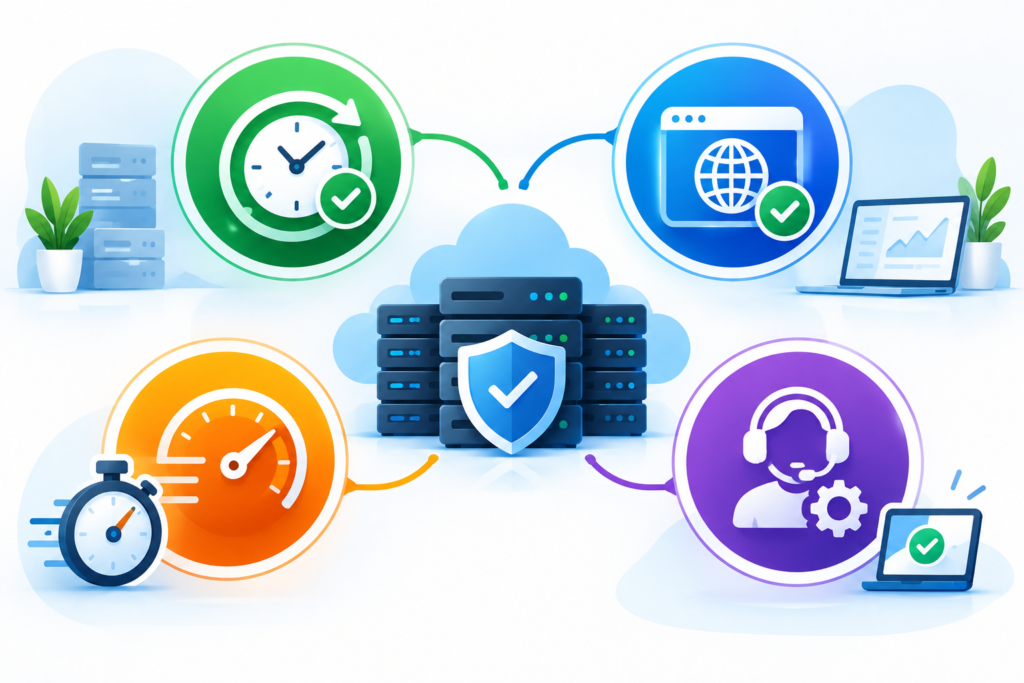
One of the most important parts of an SLA is defining how service performance will be measured.
Uptime generally describes how long a service remains operational during a specified period. Availability can be used in a similar context, although the exact definition should be stated in the agreement.
Businesses should avoid evaluating uptime percentages without understanding the measurement methodology.
For example, an SLA may advertise a very high availability target, but the agreement may exclude planned maintenance, third-party failures, customer configuration problems, or specific types of downtime.
This does not necessarily make the SLA inappropriate, but customers should understand the definitions before relying on the percentage.
Response time is another important metric.
Response time generally measures how quickly a provider acknowledges or begins handling a reported incident.
Resolution time is different. It relates to how quickly the problem is resolved, restored, or brought to an agreed operational state.
The distinction is important.
A support team could respond to a critical incident within 15 minutes but require several hours to fully restore the service. If the SLA only measures response time, the customer may incorrectly assume that the issue was handled quickly from beginning to end.
A mature SLA can therefore measure several stages:
- Incident submitted
- Incident acknowledged
- Incident assigned
- Investigation started
- Customer updated
- Service restored
- Root cause identified
- Incident closed
This creates a more complete picture of service quality.
Other useful SLA metrics may include first-response performance, recurring incidents, unresolved ticket volume, escalation frequency, backup success, maintenance compliance, and customer satisfaction.
The key is to avoid measuring metrics simply because they are easy to collect. Every metric should have a meaningful relationship with service quality.
Website Hosting and Maintenance SLAs
Website hosting and maintenance services are particularly suitable for SLA-based management because websites often support important business operations.
A website SLA may cover hosting availability, server monitoring, backups, software updates, security maintenance, technical support, emergency response, performance monitoring, and scheduled maintenance.
However, businesses should distinguish between server availability and actual website experience.
A server can remain online while a website is slow, malfunctioning, poorly configured, or difficult for users to interact with.
Modern web performance therefore requires broader monitoring.
Google’s web.dev provides guidance for building websites that are fast, accessible, secure, and compatible across browsers. Its Core Web Vitals resources cover important performance measurements and optimization techniques.
A website SLA can therefore include appropriate performance responsibilities without promising unrealistic outcomes.
For example, a provider could agree to:
- Monitor website availability
- Monitor critical pages
- Maintain backups
- Apply agreed software updates
- Investigate serious performance problems
- Respond to security alerts
- Review technical errors
- Maintain agreed support procedures
It is also important to separate technical service commitments from SEO guarantees.
No legitimate provider should promise that an SLA will guarantee a particular Google ranking. Search performance depends on many factors, including content quality, competition, search intent, technical accessibility, links, user experience, and Google’s systems.
Google’s Search Essentials provide the fundamental technical and policy framework for websites appearing in Google Search.
An SLA can support sound technical implementation, but it should not promise outcomes that the provider cannot control.
Security, Backups, and Business Continuity in SLAs
Security should be addressed explicitly when an SLA covers websites, hosting, applications, databases, cloud systems, or business-critical infrastructure.
A statement such as “security included” is not sufficiently detailed.
A useful SLA should explain which security activities are included and which responsibilities remain with the customer.
Depending on the service, security responsibilities might include:
- Security monitoring
- Software updates
- Vulnerability response
- Malware detection
- Access control
- Account protection
- Security incident escalation
- Backup monitoring
- Recovery assistance
- Configuration reviews
Backups are another area where vague promises can create risk.
Saying that a website is “backed up regularly” does not explain how often backups occur, how long they are retained, where they are stored, whether they are monitored, or whether restoration has been tested.
A more mature approach defines backup frequency, retention, verification, and restoration responsibilities.
Two useful business continuity concepts are Recovery Point Objective (RPO) and Recovery Time Objective (RTO).
RPO addresses how much recent data a business can potentially afford to lose after an incident.
RTO addresses how quickly the service should be restored following a disruptive event.
These concepts can help businesses make recovery expectations more practical.
Security responsibilities should also be divided clearly.
A provider may secure the hosting environment while the customer remains responsible for administrator passwords, user accounts, third-party applications, plugins, or content.
Clear ownership prevents dangerous assumptions.
An SLA should therefore answer a simple question:
If something goes wrong, who is responsible for doing what?
Monitoring, Reporting, and SLA Performance Measurement
A Service Level Agreement only becomes meaningful when its commitments can be measured consistently and reported transparently. An SLA should therefore define exactly how performance will be monitored, which systems will provide the evidence, how often reports will be generated, and who is responsible for reviewing the results. Without measurable data, statements such as “high availability,” “fast support,” or “secure service” can become subjective and difficult to enforce. Effective SLA management converts these expectations into observable metrics such as uptime percentage, response time, resolution time, backup success rate, incident frequency, recovery performance, and customer satisfaction.
For digital services, monitoring should cover both infrastructure and user-facing performance. A hosting or website maintenance SLA, for example, may monitor server availability, HTTP response status, resource consumption, database health, SSL certificate status, backup completion, malware alerts, and website performance. Where website experience is part of the agreement, organizations can also monitor Core Web Vitals, including Largest Contentful Paint (LCP), Interaction to Next Paint (INP), and Cumulative Layout Shift (CLS). Core Web Vitals can provide useful technical guidance when performance commitments are included in a website-related SLA. The important point is that the SLA should distinguish between a metric being monitored and a metric being contractually guaranteed.
Reporting should also be designed around decisions rather than simply producing large quantities of data. A useful monthly SLA report might show the agreed target, actual result, number of incidents, average response time, average resolution time, missed targets, root causes, corrective actions, and outstanding risks. For example, if an agreement promises a 99.9% availability target but records a lower result during a reporting period, the report should explain what happened, how long the interruption lasted, whether the event was covered by an exclusion, and what corrective action has been taken. Clear reporting creates accountability while helping both parties identify recurring weaknesses before they become major business problems.
Incident Management, Escalation, and Communication Procedures
A strong SLA should explain what happens when something goes wrong. Businesses should not have to negotiate the response process during an outage, security incident, service degradation, or critical technical failure. The agreement should establish an incident management framework that categorizes incidents according to business impact and urgency. A critical incident affecting an entire website or revenue-generating platform should receive a substantially different response from a minor content issue. Defining these categories in advance reduces confusion and enables support teams to prioritize resources appropriately.
An effective incident process normally includes identification, logging, classification, acknowledgement, investigation, escalation, resolution, validation, and closure. Each stage should have a responsible party and, where appropriate, a measurable target. For example, a critical incident might require acknowledgement within 15 minutes and continuous communication until service is restored, while a low-priority request might have a response target of one business day. The exact figures should reflect the organization’s operational capabilities rather than being copied from another company’s agreement. An SLA is strongest when its promises are realistic, measurable, and operationally achievable.
Communication requirements are equally important. During a serious incident, customers need to know whether the problem has been identified, whether service is partially or completely unavailable, what actions are being taken, and when the next update will be provided. The SLA can specify communication channels such as email, ticketing systems, telephone escalation, or an incident-management platform. It can also define escalation levels for unresolved problems. If an issue remains unresolved beyond a specified period, it might automatically move from a first-line support team to a senior engineer or service manager. A post-incident review can then document the root cause, business impact, timeline, remediation, and preventative measures. This creates a repeatable process instead of relying on ad-hoc decisions under pressure.
Security, Privacy, Compliance, and Risk Management Requirements
Security should be treated as a fundamental SLA consideration rather than an optional technical add-on. When a service provider hosts websites, manages infrastructure, stores customer information, maintains applications, or administers business systems, the SLA should clarify the security responsibilities of both parties. This can include access control, authentication, software updates, vulnerability management, malware detection, firewall configuration, encryption, logging, backup protection, incident notification, and secure administrative procedures. The agreement should also distinguish between security responsibilities controlled by the provider and responsibilities that remain with the customer.
An effective security section should explain what happens when a vulnerability or security incident is discovered. For example, the SLA can establish procedures for reporting suspected vulnerabilities, restricting compromised accounts, preserving relevant logs, investigating incidents, restoring affected services, and communicating material findings. Where personal or sensitive information is involved, the contractual relationship may also need to address applicable privacy and data-protection obligations. These requirements should be reviewed by an appropriately qualified legal or compliance professional because contractual obligations can vary substantially according to jurisdiction, industry, data type, and business relationship.
Security commitments should also be connected to practical operational controls. If backups are included, the SLA should state how frequently backups occur, how long they are retained, whether they are stored separately from production systems, and how restoration is tested. If patching is included, the agreement should explain how critical vulnerabilities are prioritized. If administrator access is provided, responsibilities around credentials, multi-factor authentication, and account termination should be clear. A vague statement such as “industry-standard security” is usually less useful than measurable obligations with defined responsibilities. Organizations should also avoid presenting an SLA as proof that a system is completely secure. No operational agreement can eliminate every cybersecurity risk; instead, an effective SLA establishes reasonable controls, accountability, monitoring, and response procedures.
Backup, Disaster Recovery, and Business Continuity SLAs
Backup and disaster recovery requirements deserve special attention because restoring a service after a serious failure involves much more than simply having a backup file. An SLA should identify the systems and information covered by backup procedures, the backup frequency, retention period, storage approach, encryption requirements, monitoring process, and restoration responsibilities. It should also distinguish between backup availability and successful recovery. A backup that exists but cannot be restored reliably does not provide the same level of protection as a tested recovery system.
Two important concepts are Recovery Point Objective (RPO) and Recovery Time Objective (RTO). RPO describes the maximum acceptable amount of data loss measured in time. If an organization has an RPO of four hours, it is effectively accepting the possibility that the most recent recoverable data could be up to four hours old. RTO describes the targeted time required to restore the service after a disruptive event. These objectives should be selected according to business impact. A small informational website may tolerate a longer restoration period, while an e-commerce platform or mission-critical application may require substantially faster recovery.
A mature SLA should also address recovery testing. A documented disaster recovery plan should be tested rather than assumed to work. Testing can reveal expired credentials, incomplete backups, incompatible software versions, missing configuration files, insufficient infrastructure capacity, or unclear responsibilities. The SLA can define how frequently recovery tests occur, how test results are documented, and what happens when a recovery objective is missed. Business continuity planning should extend beyond technology by considering communication, staffing, alternative suppliers, domain and DNS access, critical credentials, third-party dependencies, and other operational requirements. When these elements are incorporated into an SLA, the agreement becomes a practical resilience framework rather than simply a promise about uptime.
Service Credits, Remedies, Reviews, and SLA Enforcement
An SLA should explain what happens when agreed service levels are not achieved. Depending on the commercial relationship, remedies may include service credits, fee reductions, corrective action plans, escalation procedures, additional reporting, or contractual termination rights. A service credit is typically a predefined financial adjustment applied when specific service commitments are missed. However, service credits should not become the primary reason for creating an SLA. The main purpose should be to establish predictable service quality, accountability, and continuous improvement.
The agreement should clearly define the conditions under which a remedy applies. For example, an uptime commitment might specify the measurement period, calculation method, exclusions, minimum outage duration, and process for submitting a claim. Exclusions are particularly important because not every service interruption is necessarily within the provider’s control. Planned maintenance, customer-caused configuration changes, force majeure events, failures of third-party systems, or other explicitly defined circumstances may be treated differently. Ambiguous exclusions can create as much conflict as ambiguous service targets, so they should be written carefully and reviewed by the appropriate legal and commercial stakeholders.
SLA enforcement should also include periodic review. Technology, business requirements, traffic levels, security risks, and customer expectations change over time. An SLA that was appropriate two years ago may no longer reflect current operational requirements. A quarterly or annual review can assess actual performance, recurring incidents, changing workloads, new dependencies, security requirements, and whether targets remain commercially realistic. The review should consider both parties’ experiences instead of focusing solely on penalties. The most effective SLA relationships use performance data to identify opportunities for improvement, agree on realistic changes, and prevent recurring problems. In this way, enforcement becomes part of a continuous improvement cycle rather than a purely adversarial contractual process.
How to Create a High-Quality Service Level Agreement
Creating an effective SLA begins with identifying the service being provided and the business outcome the service is expected to support. Start by documenting the scope: systems, applications, websites, hosting environments, support channels, maintenance activities, security responsibilities, and operational boundaries. Next, identify the stakeholders who depend on the service and determine which failures would have the greatest business impact. This allows the agreement to prioritize the metrics that actually matter. An SLA should not contain dozens of measurements simply to appear comprehensive; every important metric should have a clear business or operational purpose.
The next step is converting expectations into measurable commitments. Instead of saying that support will be “fast,” define response targets for different priority levels. Instead of promising “excellent uptime,” establish a measurable availability target and explain how it is calculated. Instead of saying that backups are “regular,” specify frequency, retention, monitoring, and restoration testing. Documentation should also identify responsibilities, escalation procedures, maintenance windows, reporting schedules, exclusions, remedies, review periods, and termination conditions. Where the SLA concerns a website or digital platform, technical considerations such as performance, security, accessibility, backups, monitoring, and software maintenance may need to be addressed separately according to the actual service scope.
Finally, validate the agreement against operational reality. A target that sounds impressive but cannot consistently be delivered can damage trust. Before signing, the parties should confirm that the necessary people, systems, monitoring tools, infrastructure, and processes exist to support each commitment. The SLA should also be written so that a third party can understand how performance will be measured without relying on informal explanations. For website and search-related services, organizations can consult Google Search Essentials and the Google SEO Starter Guide when defining relevant technical and search-quality expectations. The result should be a clear, measurable, realistic, reviewable, and mutually understood agreement.
Service Level Agreement Best Practices for Long-Term Success
Long-term SLA success depends on treating the agreement as a living operational framework rather than a document that is signed and forgotten. The first best practice is to keep every commitment measurable. Each major service target should have a defined metric, measurement method, reporting period, owner, and escalation path. The second is to align SLA targets with business priorities. A company should invest more operational attention in services where downtime, security incidents, or slow response can create significant financial or reputational damage. This ensures that service management supports business objectives rather than becoming an administrative exercise.
Another important practice is transparency. Performance data should be available to the relevant stakeholders, particularly when targets are missed. Reports should explain what happened rather than simply presenting a pass-or-fail score. Trust is strengthened when service providers acknowledge problems, communicate clearly, and demonstrate corrective action. Organizations should also avoid creating unrealistic targets purely for marketing purposes. A sustainable SLA balances customer expectations with the provider’s actual infrastructure, staffing, technical capabilities, dependencies, and operating model.
Finally, SLAs should evolve through continuous improvement. Regular reviews should examine trends instead of isolated incidents. If response times repeatedly approach the contractual limit, the parties should investigate whether additional resources or process improvements are needed. If security incidents repeatedly originate from the same weakness, the underlying control should be improved rather than merely recording another incident. For websites and digital services, performance expectations can also be reviewed alongside real-world user experience and modern technical guidance from web.dev. Organizations should also follow Google’s people-first content principles when SLA-related website content is published, particularly where technical claims, expertise, and trust are involved. Creating Helpful, Reliable, People-First Content
Frequently Asked Questions
1. What is the main purpose of a Service Level Agreement?
The main purpose of a Service Level Agreement is to establish clear expectations between a service provider and customer. It defines the services covered, performance standards, responsibilities, measurement methods, support procedures, escalation requirements, and potential remedies when agreed targets are not achieved. A well-written SLA reduces ambiguity and creates a shared understanding of what successful service delivery looks like.
2. What should be included in an SLA?
Important components normally include the scope of services, service-level objectives, availability targets, response and resolution times, incident priorities, support hours, maintenance procedures, security responsibilities, backup requirements, reporting methods, escalation processes, exclusions, remedies, review procedures, and termination conditions. The exact contents should reflect the service being provided.
3. What is the difference between response time and resolution time?
Response time is the period between a customer reporting an issue and the service provider acknowledging or responding to it. Resolution time is the period required to resolve the underlying problem or restore the agreed service condition. These should not be treated as the same measurement because a provider can respond quickly while a technically complex problem may require significantly more time to resolve.
4. How is SLA uptime calculated?
Uptime is generally calculated by measuring the amount of time a service is available during a defined measurement period and comparing it with the total eligible service time. However, the exact calculation depends on the SLA. Planned maintenance and specifically defined exclusions may be removed from the calculation. The agreement should therefore explain the measurement methodology rather than relying on the word “uptime” alone.
5. Are service credits required in every SLA?
No. Service credits are one possible remedy, but they are not mandatory for every SLA. Some agreements may use corrective action plans, escalation procedures, additional reporting, fee adjustments, or other contractual remedies. The appropriate approach depends on the commercial relationship, service type, risk level, and negotiated terms.
6. Should cybersecurity be included in an SLA?
Where the service involves hosting, infrastructure management, software administration, customer data, or other security-sensitive operations, cybersecurity responsibilities should generally be addressed. The agreement can define areas such as patching, access management, backups, monitoring, incident notification, vulnerability response, and recovery responsibilities. Legal and compliance requirements should be assessed separately where applicable.
7. How often should an SLA be reviewed?
Many organizations review important SLAs annually, while higher-risk or rapidly changing services may benefit from quarterly or more frequent reviews. The appropriate schedule depends on the service. A review should consider actual performance, recurring incidents, changing business requirements, technology changes, security risks, capacity, and whether the existing targets remain realistic.
8. Can an SLA improve customer relationships?
Yes. A well-designed SLA can improve customer relationships by establishing predictable expectations and creating transparency around service performance. It can also make difficult conversations easier because responsibilities and escalation procedures are agreed before problems occur. However, an SLA only improves trust when the provider can actually deliver the commitments it makes.
Common Service Level Agreement Mistakes to Avoid
1. Using vague performance promises
Terms such as “quick support,” “high availability,” and “strong security” may sound professional but are difficult to measure. Replace vague language with clearly defined targets.
2. Setting unrealistic SLA targets
An extremely aggressive target is not automatically a better target. Commitments should reflect actual infrastructure, staffing, technical dependencies, and operating capabilities.
3. Ignoring exclusions
Unexpected disputes frequently arise because the agreement does not clearly explain planned maintenance, third-party failures, customer-caused incidents, or other excluded circumstances.
4. Failing to define measurement methods
Every important metric should explain what is measured, where the data comes from, when measurement begins and ends, and how the result is calculated.
5. Confusing response with resolution
Acknowledging a ticket is not the same as fixing the underlying problem. Both measurements should be defined independently when both matter.
6. Neglecting security and backup responsibilities
Security, backups, restoration, access management, and incident response should have clearly assigned responsibilities where they are part of the service.
7. Creating an SLA and never reviewing it
Business requirements change. Regular SLA reviews help ensure that service commitments remain useful and realistic.
8. Measuring too many unnecessary metrics
More metrics do not automatically produce better management. Focus on measurements that directly represent service quality, business impact, risk, and customer experience.
9. Treating the SLA as purely contractual
The best SLAs are operational documents as well as commercial agreements. Support teams should understand them and have the tools required to meet their obligations.
10. Failing to connect SLA performance to continuous improvement
Repeated failures should trigger investigation and corrective action. Recording missed targets without addressing their causes simply allows the same problems to return.
Best Practices Summary for Service Level Agreements

A high-quality SLA should follow these principles:
- Define scope clearly so both parties understand exactly what is included.
- Use measurable service levels instead of vague promises.
- Separate response time from resolution time where both metrics matter.
- Create incident priority levels based on business impact and urgency.
- Define monitoring methodology before performance disputes occur.
- Document escalation procedures for unresolved or critical incidents.
- Include security responsibilities where relevant.
- Specify backup and recovery requirements instead of simply promising backups.
- Define RPO and RTO when disaster recovery is part of the service.
- Explain exclusions and maintenance windows clearly.
- Establish reporting requirements with meaningful performance data.
- Use realistic targets that can be consistently delivered.
- Define remedies and service credits where appropriate.
- Review the SLA periodically as business and technical requirements change.
- Use performance data for continuous improvement, not just contractual enforcement.
- Keep responsibilities balanced between the provider and customer.
- Document ownership for every major service obligation.
- Make the agreement understandable to technical, operational, commercial, and management stakeholders.
A particularly useful quality check is to ask five questions for every major commitment:
What is being promised? Who is responsible? How is it measured? What happens if the target is missed? When will the commitment be reviewed?
If an SLA can answer all five clearly, it is much more likely to function effectively in real-world operations.
Conclusion
A Service Level Agreement is much more than a contractual document. When designed correctly, it becomes a practical framework for service quality, accountability, communication, security, performance management, and continuous improvement. The strongest agreements translate business expectations into measurable commitments while clearly defining responsibilities, monitoring procedures, escalation paths, exclusions, recovery requirements, and remedies.
For websites, hosting, maintenance, digital platforms, software services, and technical support, a carefully designed SLA can reduce uncertainty and provide a structured way to manage performance. It should not promise perfection; instead, it should establish realistic standards and a dependable process for measuring results, responding to incidents, recovering from failures, and improving service over time. Organizations can also use official resources such as Google Search Essentials, Google Search Central, and web.dev when relevant technical, performance, or search considerations are included in digital-service commitments.
For businesses looking to establish clearer service expectations and build a more dependable digital operation, Monthly Website Design can use these principles as a foundation for practical website and service-management planning. The objective should always be the same: create commitments that are understandable, measurable, achievable, transparent, and valuable to the people depending on the service.
Want to Implement This Easily?
Prompt Text:
You are an expert consultant. Based on the blog post titled “Service Level Agreements”, provide a step-by-step, practical implementation guide. Include tools, best practices, common mistakes to avoid, and advanced tips. Assume the reader wants to implement everything discussed in this article effectively.
Call to Action:
Want our help implementing this? Just reach out to us via our contact form.