

Learn how Service Level Agreements work, what they should include, how to define measurable service standards, manage performance, reduce operational risks, and build stronger long-term provider relationships.
Introduction
A Service Level Agreement (SLA) is a formal framework that defines the expected level of service between a service provider and a customer. It establishes what will be delivered, how service performance will be measured, who is responsible for specific activities, how incidents should be managed, and what happens when agreed service standards are not achieved. Although Service Level Agreements are commonly associated with IT and technology services, they can also be applied to website maintenance, hosting, cybersecurity, cloud infrastructure, software development, technical support, digital marketing, and other professional services.
The purpose of an SLA is to replace assumptions with clearly documented expectations. Instead of saying that a provider offers “fast support” or “reliable service,” a properly structured agreement can define specific response times, availability targets, maintenance arrangements, incident priorities, escalation procedures, reporting requirements, and customer responsibilities. This gives both parties a shared operational framework and makes service quality easier to evaluate.
A strong SLA becomes especially valuable when a problem occurs. A website outage, failed backup, security incident, application error, or major technical problem can quickly become a business-critical issue. Without agreed procedures, valuable time can be lost determining who should act, which team should be contacted, how urgent the issue is, and when management should be informed. A clear SLA provides a predefined process for handling these situations.
For businesses that depend on external digital services, an SLA can support accountability, transparency, continuity, performance management, risk reduction, and ongoing improvement. The agreement should not simply be signed and stored away. It should become a practical management tool that helps customers and providers understand service performance and continuously improve the relationship.
For Monthly Website Design, strong SLA principles can provide a structured foundation for website support, maintenance, performance monitoring, security, availability, and ongoing technical service delivery.
What Is a Service Level Agreement?
A Service Level Agreement is a documented agreement between a service provider and customer that defines specific expectations and measurable commitments relating to a service. It creates a common framework for understanding what the provider is responsible for delivering and how the customer will evaluate the service.
According to the Service Level Agreement definition provided by NIST, an SLA can address areas including service type, responsibilities, expected performance, reliability, response, reporting, resolution, and termination. This makes the concept much broader than simply promising technical support. An SLA can establish the operational rules that govern an entire service relationship.
For example, imagine a company operating an online store that experiences a complete checkout failure. Without a defined SLA, the business may not know whether the issue should be classified as critical, how quickly the provider should respond, who should investigate it, when management should be notified, or what constitutes resolution. With a well-designed SLA, these questions can already be answered.
A useful Service Level Agreement should clearly define:
- What service is being delivered
- Which systems or services are included
- What performance level is expected
- How performance will be measured
- What support hours apply
- How incidents are prioritised
- How quickly the provider should respond
- How resolution is measured
- Who is responsible for each activity
- How unresolved problems are escalated
- How service performance is reported
- How the SLA is reviewed and updated
The important distinction is between a general service promise and a measurable service commitment. “We provide reliable website support” is a broad statement. “Critical website incidents receive an initial response within the agreed critical-incident response window” is much easier to manage and evaluate.
A well-written SLA therefore creates clarity before problems happen. It gives both parties a shared reference point and reduces the likelihood that important expectations will be based on assumptions.
Why Service Level Agreements Matter to Businesses
Modern businesses often depend on external providers for essential services. Websites, hosting platforms, cloud applications, security systems, software platforms, support teams, payment integrations, and communication tools can all influence daily operations. When responsibility is distributed between a business and several providers, unclear expectations can create significant operational problems.
One of the biggest advantages of an SLA is clarity. A customer may believe that support is available around the clock, while the provider may only offer automated monitoring outside business hours. Similarly, a customer might consider a broken checkout process a critical incident, while a provider could classify it differently unless the SLA provides a clear definition. By documenting these expectations in advance, an SLA helps prevent disagreements.
An SLA also creates accountability. If a provider commits to a particular response time for critical incidents, that commitment can be measured. Management can review actual performance rather than relying on assumptions or isolated experiences. This is especially useful when businesses work with multiple suppliers and need to understand which organisation is responsible for specific parts of the service.
Another important advantage is risk management. A strong SLA encourages organisations to think about what happens when services fail. It can define escalation procedures, communication requirements, backup expectations, maintenance arrangements, security responsibilities, and recovery objectives.
For example, a business website may have different operational requirements depending on its purpose. A simple informational website may tolerate a longer maintenance window, whereas an e-commerce website may require rapid incident response because downtime can directly affect customer transactions.
Service Level Agreements can therefore help businesses:
- Establish measurable expectations.
- Improve supplier accountability.
- Clarify responsibilities.
- Improve incident handling.
- Reduce communication problems.
- Support business continuity.
- Monitor service performance.
- Identify recurring failures.
- Improve supplier relationships.
- Create a structured improvement process.
The value of an SLA is ultimately determined by how well it reflects real business requirements. A long agreement is not automatically an effective agreement. The most useful SLA is one that clearly connects service commitments with the operational priorities of the organisation.
Main Objectives of an Effective Service Level Agreement
The first objective of an effective SLA is to establish clear expectations. Both parties should understand exactly what service is being provided, what is included, what is excluded, and what responsibilities belong to each side. This reduces the possibility of misunderstandings and makes operational decisions easier.
The second objective is to establish measurable service standards. An agreement should convert important expectations into practical metrics whenever possible. Instead of saying that a provider should respond quickly, the SLA can establish response targets according to incident priority. Instead of promising reliable availability, the SLA can define how availability is measured and reported.
The third objective is to create a framework for accountability and continuous improvement. Service performance should be reviewed regularly so that recurring problems can be identified. If a provider consistently meets response targets but the same technical issue occurs every month, the SLA management process should encourage investigation of the underlying cause.
An effective SLA should support several business objectives at the same time.
Clarity
The agreement should make service expectations easy to understand.
Measurement
Important service characteristics should be measurable through agreed metrics.
Accountability
Responsibilities should be assigned clearly rather than left to assumptions.
Communication
Both parties should know how incidents, changes, and performance issues will be communicated.
Escalation
There should be a defined route for problems that cannot be resolved through normal support channels.
Improvement
Performance information should be used to improve the service rather than simply recorded for administrative purposes.
Risk Management
The agreement should identify important service dependencies and define procedures for handling disruption.
The best SLA objectives are connected to actual business outcomes. For example, a business may not care about technical uptime as an isolated number. What matters may be whether customers can access products, submit forms, complete purchases, or use essential services.
This distinction is important because technical performance and business performance are not always identical. A mature SLA therefore measures the characteristics that genuinely matter to users and business operations.
Essential Components of a Service Level Agreement
A comprehensive SLA should begin with a clear service description and scope. This section should explain exactly what the provider is delivering and which systems, platforms, websites, applications, or services are covered. It should also identify exclusions so that both parties understand where the provider’s responsibilities end.
The service-level section should then establish the measurable standards that apply. These may include availability, response time, resolution time, support hours, planned maintenance, incident priorities, escalation requirements, and reporting obligations. Each metric should have a clear definition.
For example, if an SLA states that the provider will respond to a critical incident within one hour, the agreement should clarify what “response” means. Does it mean an automated acknowledgement, a support representative contacting the customer, or a technical specialist beginning investigation? Precise definitions prevent disputes later.
Roles and responsibilities are equally important. The provider may be responsible for monitoring, backups, software updates, technical troubleshooting, and infrastructure management. The customer may be responsible for approving changes, providing access, maintaining account information, or responding to support requests.
Important SLA components commonly include:
Service Scope
Defines the exact services covered by the agreement.
Service Hours
Establishes when support and service commitments apply.
Availability
Defines expected service availability and the calculation method.
Performance Metrics
Identifies the measurements used to evaluate service quality.
Incident Priorities
Defines categories such as critical, high, medium, and low.
Response Targets
Defines how quickly different types of incidents should receive attention.
Resolution Targets
Defines how restoration or resolution is measured.
Maintenance Windows
Identifies when planned maintenance may occur and how customers will be notified.
Escalation Procedures
Defines what happens when normal support processes are insufficient.
Reporting
Explains how performance data will be collected and communicated.
Security Responsibilities
Defines responsibilities for security controls, access, patching, monitoring, and incidents.
Customer Responsibilities
Explains what the customer must provide or perform for the service to operate properly.
Review Procedures
Defines how the agreement is reviewed, updated, and improved.
A strong SLA should also identify dependencies. If a service relies on a third-party payment provider, hosting platform, API, domain registrar, or external software system, the agreement should make the relevant dependency clear.
Different Types of Service Level Agreements
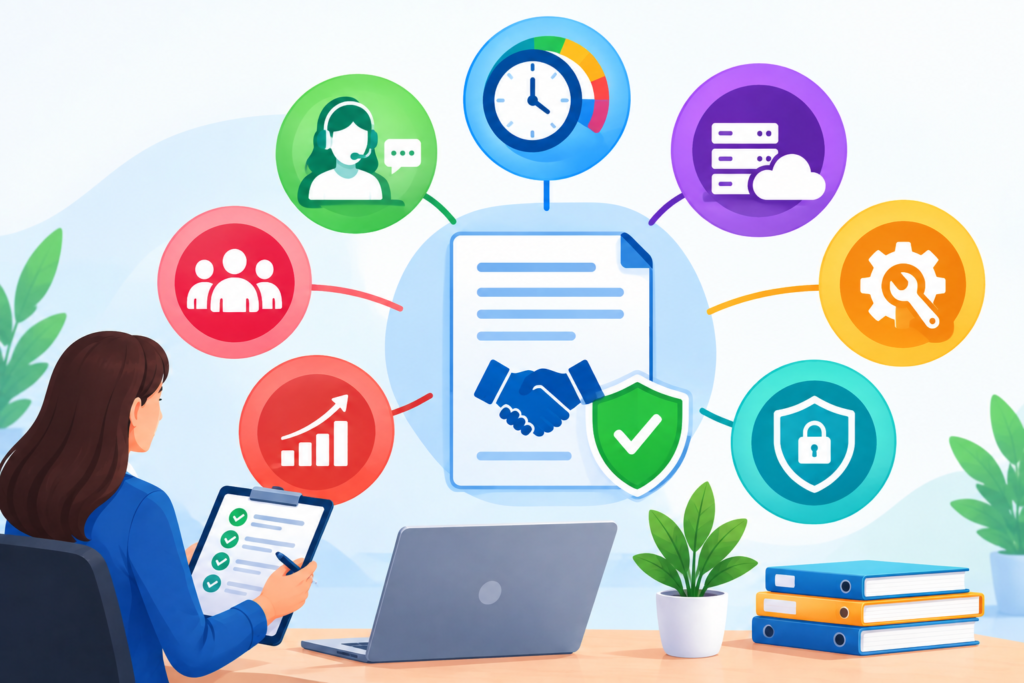
Different business relationships require different SLA structures. There is no universal format that works equally well for every service provider and customer.
A customer-based SLA is designed around the requirements of a particular customer. This can be useful when the customer has unique operational needs. For example, a large online retailer may require different support coverage from a small business operating a simple informational website.
A service-based SLA establishes a standard level of service for a particular service offered to multiple customers. This can help providers standardise their operations and make service delivery more predictable. However, the service description must be clear enough that customers understand exactly what they are receiving.
A multi-level SLA combines different levels of requirements. An organisation may have broad service standards, customer-specific commitments, and individual technical requirements for specific services.
The choice of SLA structure should depend on business complexity, service criticality, customer requirements, and operational risk.
For example, a basic website support SLA might focus on:
- Website availability.
- Security updates.
- Backups.
- Technical support.
- Incident response.
- Maintenance.
- Performance monitoring.
A more complex enterprise technology SLA might additionally cover:
- Multiple support tiers.
- 24/7 monitoring.
- Disaster recovery.
- Security incident management.
- Data protection.
- Infrastructure performance.
- Supplier dependencies.
- Detailed reporting.
- Business continuity.
- Formal service governance.
The goal is not to make an SLA unnecessarily complicated. The goal is to create the right level of detail for the service being managed.
A small organisation should not necessarily copy the SLA structure of a multinational technology company. Excessive complexity can make the agreement difficult to understand and even harder to operate.
The most effective approach is to begin with business requirements and work backwards toward the appropriate SLA structure.
SLA Metrics and Key Performance Indicators
Metrics are the foundation of effective SLA management because they transform general expectations into measurable performance indicators. Common SLA metrics include availability, response time, resolution time, incident volume, customer satisfaction, first-contact resolution, backup success, recovery performance, and escalation frequency.
However, not every available metric belongs in an SLA. Organisations should focus on indicators that provide meaningful information about service quality, business impact, operational stability, or risk.
Response time and resolution time should normally be measured separately. Response time identifies how quickly a provider acknowledges or begins addressing an issue. Resolution time measures how long it takes to restore service or deliver the agreed resolution.
Consider a critical website outage. The provider may respond within ten minutes but require two hours to identify and correct a complex server problem. The response target has been met, but the resolution target may not have been. Separating these measurements gives management a more accurate picture of performance.
Availability also requires careful definition. A target such as 99.9% uptime may sound straightforward, but the SLA should explain the measurement period, monitoring system, maintenance exclusions, third-party dependencies, and treatment of partial service failures.
For websites, user-focused performance can also be incorporated where appropriate. Google’s Core Web Vitals provide standardised metrics for evaluating important aspects of real-world web experience, including loading performance, responsiveness, and visual stability.
Useful SLA metrics can include:
| Metric | What It Measures |
|---|---|
| Availability | Whether the service remains accessible |
| Response Time | Speed of support engagement |
| Resolution Time | Speed of restoring or resolving service |
| Incident Volume | Number of reported problems |
| Critical Incidents | Major service disruptions |
| Backup Success | Reliability of backup operations |
| Recovery Performance | Ability to restore services |
| Customer Satisfaction | User perception of service |
| Recurring Incidents | Repeated operational problems |
| Escalations | Problems requiring higher-level intervention |
Metrics should also be reviewed as trends rather than isolated figures. A single month of good performance does not necessarily mean that a service is healthy. Looking at several months of data can reveal recurring problems, deteriorating performance, or improvements resulting from corrective action.
The purpose of metrics is therefore not simply to create a scorecard. They should help answer a more important question:
Is the service reliably delivering what the business actually needs?
Response Time, Resolution Time, and Incident Priorities
Not all incidents have the same level of urgency or business impact. A complete website outage, a failed payment system, and a minor content correction should not automatically receive identical treatment. Effective SLAs therefore classify incidents according to impact and urgency.
A common framework uses four priority levels.
Critical
A critical incident causes major service disruption or prevents essential business functionality from operating.
High
A high-priority incident significantly affects an important service or group of users but may not completely stop operations.
Medium
A medium-priority issue affects a limited function, smaller group of users, or non-critical process.
Low
A low-priority request may involve minor defects, general questions, routine assistance, or cosmetic changes.
These categories should be customised according to the customer’s business. What is critical for one organisation may be medium priority for another.
The SLA should then define response expectations for each priority. A critical incident may require immediate human attention, while a low-priority request may be handled during normal support operations.
It is also important to define resolution accurately. A temporary workaround may restore service without permanently fixing the underlying cause. Therefore, the SLA can distinguish between:
Response → Investigation → Workaround → Service Restoration → Permanent Resolution → Review
This distinction is particularly useful for complex technical incidents.
Escalation should also be documented. If a critical problem remains unresolved for a defined period, it may need to be escalated to a senior engineer, incident manager, service manager, or executive contact.
Communication requirements should accompany escalation. Customers should know how frequently they will receive updates, which communication channel should be used, and what information each update should contain.
An effective incident framework therefore connects:
Priority + Response + Communication + Investigation + Resolution + Escalation
This creates a consistent process that can be applied during stressful situations rather than requiring staff to invent procedures during an emergency.
Monitoring, Reporting, and SLA Governance
An SLA cannot be effectively managed without reliable monitoring. Monitoring provides the evidence required to determine whether agreed service commitments are being achieved.
Depending on the service, monitoring may cover website uptime, application availability, server health, response times, backup status, security events, support tickets, performance indicators, infrastructure resources, and service incidents.
Reporting transforms this information into a form that management can understand and act upon. A useful monthly SLA report may contain:
- Service availability.
- Response-time performance.
- Resolution-time performance.
- Number of incidents.
- Critical incidents.
- SLA breaches.
- Recurring issues.
- Planned maintenance.
- Security events.
- Open incidents.
- Corrective actions.
- Service improvement recommendations.
The objective is not to produce a report simply because the SLA says a report must exist. The objective is to understand what happened, why it happened, and what should change.
For websites, Google Search Console can provide useful information about search performance, indexing, and how Google understands website pages. Where SEO-related responsibilities form part of a wider digital service arrangement, such information may complement technical service reporting.
Governance provides the structure for reviewing this information. Regular service review meetings can examine whether targets remain appropriate, whether incidents are recurring, whether business requirements have changed, and whether improvement actions have been completed.
A strong governance process should answer:
Did the service meet its commitments?
Which problems occurred?
Which problems happened repeatedly?
What caused the problems?
What was the business impact?
What corrective action is required?
Do the current SLA targets still reflect business needs?
Monitoring should also be transparent. Both parties should understand where performance data comes from and how calculations are made. If a provider’s monitoring platform is the official source of SLA data, the measurement methodology should be documented.
Ultimately, SLA governance should create a continuous improvement cycle:
Measure → Analyse → Discuss → Correct → Improve → Measure Again
This makes the SLA an active management framework rather than a static contractual document.
Service Availability, Reliability, and Business Continuity
Availability is one of the most common SLA measurements, but availability does not always equal reliability. A website may technically remain online while important functions fail. Pages might load, but users could be unable to log in, submit forms, complete payments, or access essential services.
For this reason, organisations should distinguish between simple uptime and meaningful service availability.
A mature SLA can combine availability with additional indicators such as transaction success rates, application response times, error rates, incident frequency, backup performance, and recovery results.
Business continuity should also form part of an SLA when service disruption could have significant consequences.
Important concepts include:
Recovery Time Objective
The Recovery Time Objective (RTO) defines the targeted period for restoring a service following disruption.
Recovery Point Objective
The Recovery Point Objective (RPO) defines the acceptable amount of data loss measured in time.
Backup Frequency
Defines how often important data should be backed up.
Backup Retention
Defines how long backup copies should remain available.
Recovery Testing
Establishes how restoration procedures are tested to confirm that backups are actually usable.
Incident Communication
Defines how customers, management, and other stakeholders are informed during significant disruption.
These requirements should reflect the importance of the service.
For example, an informational website may tolerate a longer recovery period than an online store processing customer orders throughout the day.
Modern digital services also depend on interconnected third parties. A website may rely on hosting providers, domain services, DNS infrastructure, payment processors, email systems, APIs, content delivery networks, plugins, and external software platforms. An SLA should identify important dependencies and clarify which party controls each part of the service.
NIST’s guidance on cloud service metrics provides useful background on measurable service characteristics and technical requirements for evaluating cloud services.
The purpose of business continuity provisions is not to claim that failures can never happen. Instead, the SLA should establish a practical framework for:
Prevention → Detection → Response → Recovery → Communication → Improvement
That framework gives both parties a clearer understanding of what should happen when normal operations are interrupted.
Security Responsibilities Within a Service Level Agreement
Security responsibilities should be clearly defined whenever an SLA covers websites, applications, hosting, cloud infrastructure, databases, software, or other business-critical technology. A vague security clause can create significant gaps because both the customer and provider may assume that the other party is responsible for a particular security activity. A strong SLA removes that uncertainty by identifying who manages security controls, software updates, access permissions, monitoring, backups, vulnerability handling, and incident response.
The first step is to establish clear security ownership. For example, a service provider might be responsible for server security, operating-system patching, malware monitoring, and infrastructure protection, while the customer remains responsible for user accounts, passwords, authorised access, and business-level permissions. In another arrangement, the provider may manage website software, plugins, backups, security scanning, and technical hardening. The correct division depends on the service architecture and contractual responsibilities.
Security requirements should also reference recognised technical practices. The OWASP Top 10 provides an established awareness framework for common web application security risks, while the current OWASP Top 10:2025 provides the latest published version of that project. These resources can help organisations identify areas that may need consideration when defining application-security responsibilities within an SLA.
Security incident management should be particularly specific. The agreement should explain what constitutes a security incident, how quickly the provider should notify the customer, which communication channel should be used, who investigates the issue, and how remediation is coordinated. It should also clarify responsibilities for preserving relevant information, restoring affected services, reviewing the incident, and preventing recurrence.
A comprehensive security section can address:
- Security monitoring.
- Vulnerability management.
- Software and system patching.
- Malware detection.
- Access management.
- Authentication controls.
- Backup protection.
- Security incident notification.
- Incident investigation.
- Security remediation.
- Third-party security dependencies.
- Customer security responsibilities.
- Security review procedures.
Security responsibilities should also be reviewed periodically. Websites, applications, plugins, cloud services, integrations, and infrastructure change over time. A security commitment that was appropriate when an SLA was created may no longer reflect the current risk environment.
The objective is to create a clear security responsibility model where both parties understand what they must protect, monitor, report, and maintain.
SLA Challenges and How to Manage Them
Creating an SLA is relatively straightforward; creating one that works effectively in real-world operations requires more careful planning. One of the biggest challenges is setting unrealistic service targets. Customers may request extremely short response or resolution times without considering technical complexity, staffing requirements, dependencies, or the resources required to meet those commitments consistently.
A better approach is to establish service levels based on business impact and operational requirements. A critical service should receive appropriate priority, but targets should still be achievable and measurable. Providers should understand what resources are required to meet the agreed standards, while customers should understand the operational limitations that can affect service delivery.
Another common challenge is poorly defined measurement. A target such as “99.9% uptime” appears precise, but disagreements can arise over how availability is calculated. The SLA should explain the monitoring source, measurement period, planned maintenance treatment, third-party failures, partial service interruptions, and other relevant exceptions.
Scope creep is another major problem. Customers may gradually begin requesting services that were not included in the original agreement. Providers may also introduce new systems, technologies, or processes without updating the SLA. Over time, the document can become disconnected from the actual service.
Regular SLA reviews can reduce this problem. The review process should consider:
Has the service changed?
Have customer requirements changed?
Are the existing metrics still meaningful?
Are the service targets still realistic?
Are recurring incidents being addressed?
Have new security or performance requirements emerged?
Communication can also become challenging. A technically detailed SLA may be useful for service managers but difficult for senior business stakeholders to interpret. The agreement should therefore distinguish between operational detail and management-level reporting.
Another challenge occurs when organisations focus too heavily on SLA compliance rather than service quality. A provider may technically meet a response-time target while the same underlying problem occurs repeatedly. A mature SLA process should therefore examine both compliance and the broader health of the service.
The most effective approach is to treat SLA management as a partnership focused on measurable service outcomes, clear accountability, transparent communication, and continuous improvement.
Common Service Level Agreement Mistakes to Avoid
One of the most common SLA mistakes is using vague language. Expressions such as “quick support,” “excellent performance,” “high availability,” or “reasonable response” sound positive but provide little practical value. If a requirement is important, it should be defined in a way that allows both parties to understand and evaluate it.
Another common mistake is creating an SLA with too many metrics. An agreement containing dozens of KPIs may look comprehensive, but excessive measurement can make the document difficult to operate. Teams may spend more time preparing reports than improving service. The better approach is to identify the metrics that directly relate to customer experience, business impact, service reliability, security, and operational risk.
Failing to define exclusions is also problematic. Providers may depend on third-party services, customer-controlled systems, external APIs, domain registrars, payment processors, or other infrastructure. These dependencies should be documented clearly. However, exclusions should not become an overly broad method of avoiding accountability. Each exclusion should have a genuine operational reason and clear boundaries.
Another mistake is failing to define customer responsibilities. Service delivery often depends on customer actions. Customers may need to approve changes, provide administrator access, respond to support requests, maintain credentials, or provide accurate technical information. If these responsibilities are omitted, service delays can become difficult to manage.
Other common mistakes include:
- Defining response time but not resolution time.
- Measuring uptime without defining how it is calculated.
- Failing to classify incident priorities.
- Not establishing escalation procedures.
- Ignoring maintenance windows.
- Failing to document support hours.
- Reporting performance without analysing trends.
- Ignoring recurring incidents.
- Treating security responsibilities as undefined.
- Failing to test backup and recovery processes.
- Allowing scope creep.
- Never reviewing the SLA after implementation.
- Using complicated terminology that operational teams do not understand.
- Creating targets that are difficult to measure objectively.
- Focusing on contractual penalties instead of service improvement.
A particularly important mistake is allowing the SLA to become outdated. Digital services change continuously. Websites are redesigned, applications are upgraded, cloud infrastructure evolves, security threats change, and customer expectations develop. If the SLA remains unchanged, it may eventually describe a service that no longer exists.
An effective review process should therefore examine both the agreement and the service itself.
The goal is not to create an SLA that is perfect forever. The goal is to create an agreement that can adapt as the service, technology, and business requirements change.
Best Practices for Creating and Managing Effective SLAs
The first best practice is to begin with business requirements rather than provider capabilities. Before defining service levels, identify which services are most important to the organisation, what would happen if they became unavailable, which users depend on them, and what level of support is genuinely required.
The second best practice is to make important commitments specific and measurable. Define support hours, incident priorities, response expectations, resolution objectives, availability calculations, maintenance windows, escalation procedures, and reporting requirements.
The third best practice is to create a reliable measurement system. Decide which tools will collect performance information, how calculations will be made, which events are excluded, and how both parties can review the results.
For website services, recognised technical guidance can help establish a stronger foundation. Google Search Essentials provides Google’s guidance around technical requirements, spam policies, and key practices relevant to appearing in Google Search.
Performance-related requirements should also be connected to meaningful user experience. Where appropriate, Core Web Vitals can provide a useful framework for evaluating important aspects of real-world website performance.
Security responsibilities should be clearly defined rather than assumed. Organisations managing web applications can use the OWASP Top 10 as an awareness resource when considering common application-security risks.
Another best practice is to establish regular service reviews. A monthly or quarterly review can examine:
- SLA compliance.
- Incident patterns.
- Response performance.
- Resolution performance.
- Availability.
- Security issues.
- Customer feedback.
- Recurring problems.
- Upcoming service changes.
- Improvement actions.
Service reviews should not simply ask whether targets were met. They should investigate whether the service is becoming more reliable and whether the SLA still reflects business requirements.
An effective improvement cycle is:
Define → Measure → Monitor → Report → Analyse → Improve → Review
This cycle turns an SLA from a static document into an ongoing management process.
Another important practice is to keep the agreement understandable. Technical precision is important, but unnecessary complexity can reduce usability. Operational teams should be able to quickly determine how an incident should be classified, who should be contacted, and what response is expected.
Finally, every important metric should have an owner. If nobody is responsible for monitoring a target, reviewing failures, and initiating corrective action, the metric is unlikely to produce meaningful improvement.
The Future of Service Level Agreements
The role of Service Level Agreements is changing as organisations become more dependent on interconnected digital systems. Traditional SLAs often focused on uptime, response times, and ticket management. Modern service relationships increasingly need to address security, resilience, user experience, automation, cloud dependencies, data protection, and business outcomes.
Automation is likely to play a larger role in SLA monitoring. Modern monitoring systems can automatically detect outages, performance degradation, failed backups, infrastructure problems, security events, and recurring incidents. Automated reports can then provide stakeholders with near-real-time information about service health.
However, automation does not remove the need for human judgement. A monitoring platform can identify that a website has become slower, but it may not understand the commercial consequences. Similarly, an automated system can identify repeated incidents without necessarily determining which long-term improvement should receive priority.
Artificial intelligence can also assist with service management by helping classify incidents, summarise support histories, detect recurring patterns, identify anomalies, and assist with knowledge management. Organisations should nevertheless consider appropriate controls around security, privacy, data access, accuracy, and human oversight.
Another important development is the movement from purely technical measurements toward user and business outcomes. A website can technically achieve excellent uptime while customers experience broken forms, slow checkout, confusing navigation, or failed transactions.
For this reason, future SLAs are likely to combine infrastructure measurements with customer experience indicators.
For example, instead of measuring only whether a website responds to a monitoring request, an organisation might also examine whether important customer journeys function correctly.
This creates a broader service model:
Infrastructure Health + Application Performance + User Experience + Security + Business Outcome
Web performance standards are also becoming increasingly focused on real users. Core Web Vitals provide a framework for measuring important aspects of real-world user experience.
The future SLA is therefore likely to become less like a static contractual document and more like a living service-management framework supported by continuous monitoring, data analysis, automation, security controls, and regular improvement.
How to Build a High-Performance SLA Management System
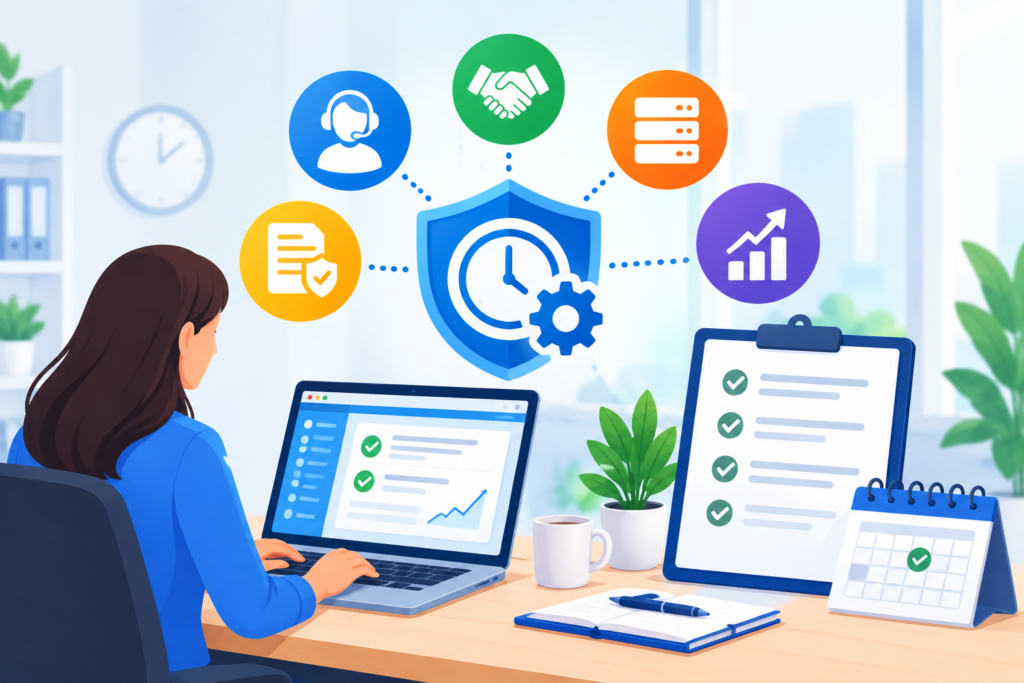
Building an effective SLA management system starts by identifying the services that are most important to the organisation. Create a clear inventory of websites, applications, platforms, infrastructure, support services, and external providers. For each service, identify who owns it, who depends on it, what systems support it, and what would happen if the service became unavailable.
The next stage is to define business priorities and service requirements. Determine which services are critical, which incidents require immediate attention, which performance indicators matter, and what level of availability is appropriate.
For each important service, establish:
- Service scope.
- Service hours.
- Incident categories.
- Response targets.
- Resolution objectives.
- Availability requirements.
- Maintenance procedures.
- Escalation procedures.
- Security responsibilities.
- Monitoring requirements.
- Reporting requirements.
- Review procedures.
The third stage is implementation. Assign SLA ownership, configure monitoring, establish reporting, document escalation procedures, and train the people responsible for managing incidents.
A practical implementation cycle can follow these steps:
Step 1: Identify Critical Services
Determine which services have the greatest operational importance.
Step 2: Define Service Scope
Document exactly what the provider is responsible for delivering.
Step 3: Identify Responsibilities
Separate provider responsibilities from customer responsibilities.
Step 4: Establish Service Levels
Create measurable availability, response, resolution, and performance targets.
Step 5: Define Incident Priorities
Create clear definitions for critical, high, medium, and low-priority issues.
Step 6: Establish Monitoring
Choose appropriate monitoring systems and define how performance will be measured.
Step 7: Create Reporting
Develop regular reports that show performance, incidents, trends, and improvement actions.
Step 8: Establish Escalation
Define who becomes responsible when normal support processes are insufficient.
Step 9: Analyse Recurring Problems
Identify patterns instead of treating every incident as an isolated event.
Step 10: Improve Continuously
Use evidence from SLA performance to improve the service.
For website performance, PageSpeed Insights can provide performance analysis and recommendations that may complement a broader website-service monitoring process.
For search-related website requirements, Google Search Console can provide information about search visibility, indexing, and website performance in Google Search.
A high-performance SLA management system should ultimately connect technical performance with business objectives.
The purpose is not simply to demonstrate that a provider achieved a particular percentage or response target. The purpose is to ensure that the service remains reliable, secure, measurable, understandable, and aligned with business needs.
Frequently Asked Questions
What is the purpose of a Service Level Agreement?
The purpose of a Service Level Agreement is to establish clear and measurable expectations between a service provider and customer. It defines the service scope, responsibilities, performance standards, support procedures, incident priorities, reporting requirements, and escalation processes.
A well-designed SLA reduces uncertainty and provides both parties with a shared framework for managing service quality.
What should a Service Level Agreement contain?
A Service Level Agreement should normally contain the service scope, service hours, availability requirements, performance metrics, response and resolution targets, incident priorities, customer and provider responsibilities, maintenance arrangements, escalation procedures, reporting requirements, security responsibilities, exclusions, review procedures, and relevant contractual remedies.
The exact structure should depend on the service and its importance to the business.
What is the difference between response time and resolution time?
Response time measures how quickly the provider acknowledges or begins addressing an incident.
Resolution time measures how long it takes to restore the service or provide the agreed resolution.
These measurements should be separated because a provider can respond quickly while a technically complex issue may require significantly more time to resolve.
How should SLA performance be measured?
SLA performance should be measured using agreed metrics and clearly documented calculation methods. Common metrics include availability, response time, resolution time, incident volume, service-request completion, backup success, recovery performance, and customer satisfaction.
The SLA should define the measurement period, monitoring source, calculation method, exclusions, and reporting process.
How often should an SLA be reviewed?
An SLA should be reviewed regularly and whenever significant changes occur. Many organisations use monthly or quarterly operational reviews combined with a broader annual review.
The SLA should also be reviewed after major service changes, website redesigns, infrastructure migrations, significant incidents, security changes, or changes in business requirements.
Can an SLA include service credits or penalties?
An SLA can contain commercially agreed remedies when service commitments are not achieved. These may include service credits, corrective action plans, additional reporting, escalation, or other contractual remedies.
The important requirement is that the underlying service target must be clearly defined and objectively measurable.
Should website performance be included in an SLA?
Website performance can be included when it is important to business operations or customer experience. The SLA should specify exactly what is measured, which tools or data sources are used, how often measurements are collected, and what action occurs when agreed thresholds are missed.
For relevant websites, Core Web Vitals can provide useful user-focused performance measurements.
Is a Service Level Agreement legally binding?
The legal effect of an SLA depends on the wider contractual arrangement, how the SLA has been incorporated into that agreement, and the applicable jurisdiction.
Businesses entering significant commercial arrangements should obtain appropriate legal advice rather than assuming that every SLA provision automatically has the same legal status.
Common Service Level Agreement Mistakes
A common mistake is using vague terminology. Words such as fast, reliable, reasonable, and high quality may sound professional but do not establish measurable requirements.
Another mistake is creating unrealistic targets. Extremely aggressive response and resolution requirements may be difficult to maintain consistently and can create unnecessary disputes.
Organisations also frequently measure the wrong things. A large number of metrics does not necessarily provide better visibility. The most useful metrics are those connected to service reliability, business impact, user experience, security, and operational requirements.
Failing to define exclusions is another problem. Third-party services, customer-controlled systems, planned maintenance, external APIs, and infrastructure dependencies should be clearly documented.
Customer responsibilities should also be included. If a provider requires administrator access, approvals, technical information, or customer cooperation, these requirements should be clearly stated.
Other common mistakes include:
- Not defining support hours.
- Failing to distinguish incidents from service requests.
- Not establishing incident priorities.
- Measuring response but ignoring resolution.
- Defining uptime without a calculation method.
- Failing to establish escalation procedures.
- Ignoring recurring incidents.
- Treating security as an undefined responsibility.
- Failing to test backups.
- Ignoring third-party dependencies.
- Allowing service scope to expand without updating the SLA.
- Never reviewing the SLA.
- Creating excessive numbers of KPIs.
- Producing reports without taking corrective action.
The most damaging mistake is often treating the SLA as a one-time document. Service environments change continuously. A useful SLA must evolve alongside technology, business requirements, customer expectations, and operational risks.
Best Practices Summary
An effective Service Level Agreement should be:
Specific: Define service scope, responsibilities, priorities, and expectations clearly.
Measurable: Use meaningful metrics with documented calculation methods.
Business-focused: Connect technical commitments to actual business requirements.
Transparent: Make monitoring and reporting understandable to both parties.
Realistic: Set targets that can genuinely be delivered and measured.
Security-aware: Define security responsibilities and incident procedures.
Performance-focused: Measure meaningful service and user-experience indicators.
Flexible: Allow the agreement to evolve when services and business requirements change.
Actionable: Establish clear escalation and corrective-action processes.
Reviewable: Evaluate performance regularly and update the agreement when necessary.
For search-related website requirements, Google Search Essentials provides Google’s guidance covering technical requirements, spam policies, and important considerations for appearing in Google Search.
For web application security, OWASP Top 10 provides a recognised awareness framework for common web application security risks.
For website performance, Core Web Vitals provide user-focused measurements that can be incorporated into appropriate performance-management processes.
The central SLA principle can be summarised as:
Define → Measure → Monitor → Report → Analyse → Improve
An SLA delivers the greatest value when these activities become part of normal service management rather than occasional administrative exercises.
Conclusion
A Service Level Agreement provides a structured way to connect business expectations with measurable service delivery. It establishes what a provider is expected to deliver, how performance will be measured, who is responsible for different activities, how incidents should be handled, and how service quality can improve over time.
A strong SLA should not be created simply to make a contract appear more comprehensive. It should address the real operational requirements of the organisation. Availability, response times, resolution objectives, security responsibilities, performance metrics, monitoring, escalation, reporting, and business continuity should all be defined according to the importance and complexity of the service.
For digital businesses, these considerations are increasingly important. Websites, applications, hosting platforms, cloud environments, and online services can directly influence customers, revenue, communication, and business operations. A service disruption can therefore have consequences beyond the technical problem itself.
A well-managed SLA helps organisations prepare for these situations. It creates a consistent framework for prevention, monitoring, incident response, recovery, communication, accountability, and improvement.
For Monthly Website Design, applying these principles can provide a stronger framework for managing website maintenance, technical support, performance, security, availability, and ongoing service delivery.
The strongest SLA is not necessarily the longest one. It is the agreement that both parties understand, can measure, can operate consistently, and are prepared to review as the service evolves.
Ultimately, effective SLA management follows a simple principle:
Set clear expectations. Measure actual performance. Learn from the evidence. Improve the service continuously.
Want to Implement This Easily?
Prompt Text:
You are an expert consultant. Based on the blog post titled “Service Level Agreements”, provide a step-by-step, practical implementation guide. Include tools, best practices, common mistakes to avoid, and advanced tips. Assume the reader wants to implement everything discussed in this article effectively.
Call to Action: Want our help implementing this? Just reach out to us via our website contact form.