

Discover how Service Level Agreements define service scope, uptime, response times, security, maintenance, monitoring, reporting, escalation, and accountability for reliable digital services.
Introduction
A Service Level Agreement (SLA) is a formal framework that establishes clear expectations between a service provider and its customer. Rather than relying on broad promises such as “fast support,” “reliable hosting,” or “regular maintenance,” an SLA turns those expectations into measurable service commitments.
For businesses that depend on websites, hosting, technical support, cybersecurity, cloud infrastructure, software, or ongoing website maintenance, this clarity can be extremely valuable. When something goes wrong, both parties should understand what constitutes a critical incident, how quickly it should be acknowledged, who is responsible for handling it, how escalation works, and how performance will be measured.
For Monthly Website Design, Service Level Agreements can provide a structured foundation for managing ongoing digital services. Website operations can involve hosting, backups, software updates, security maintenance, performance monitoring, troubleshooting, technical support, and planned maintenance. A properly designed SLA brings these responsibilities together into an understandable framework.
A strong SLA is not simply a long contractual document. It is an operational agreement that connects expectations with measurable outcomes.
It should explain what the customer receives, what the provider is responsible for, how service performance is measured, what happens when an incident occurs, and how both parties review the relationship over time.
This guide explores the essential elements of Service Level Agreements, including uptime, response times, resolution targets, technical support, website maintenance, security, backups, performance monitoring, reporting, escalation, continuous improvement, implementation, common mistakes, and best practices.
The objective is simple: create an SLA that provides clarity, accountability, measurable performance, realistic expectations, and long-term service confidence.
What Is a Service Level Agreement and Why Does It Matter?
A Service Level Agreement is a documented agreement that defines the expected level of service between a provider and a customer. Depending on the relationship, it can describe availability, support hours, response targets, resolution targets, maintenance responsibilities, security procedures, reporting requirements, escalation processes, and agreed remedies.
The exact content depends on the service.
A managed hosting SLA may focus heavily on infrastructure availability, server monitoring, maintenance windows, backup procedures, and incident response. A website maintenance SLA may concentrate on software updates, security, troubleshooting, performance, backups, and technical support. An IT support agreement may focus on ticket priorities, response times, help-desk availability, escalation, and resolution.
The central principle is measurable clarity.
For example, saying that a provider offers “fast technical support” does not establish a meaningful service level. A stronger agreement might define support hours, identify priority categories, establish an acknowledgement target, specify communication channels, and explain how critical incidents are escalated.
This distinction becomes especially important when something goes wrong.
Imagine that a business website suddenly becomes unavailable. Without an SLA, the customer may not know whether the issue is considered an emergency, whether support is available outside normal working hours, who should be contacted, how quickly someone will respond, or whether the problem falls within the provider’s responsibility.
A clearly written SLA can answer those questions before an emergency happens.
An SLA also creates a shared vocabulary. Important terms such as availability, incident, response time, resolution time, maintenance window, critical incident, service request, and escalation should have clearly defined meanings.
This reduces the possibility of different interpretations.
It is also important to avoid making promises about things the provider cannot control.
A website may depend on a third-party payment gateway, API, domain registrar, cloud platform, plugin developer, or external software provider. A responsible SLA should distinguish between services directly controlled by the provider and external dependencies.
The importance of realistic commitments is particularly clear when technical SEO is included within a broader service. Businesses can use official Search Essentials guidance to understand Google’s published requirements and best practices for search visibility. Search Essentials
Similarly, providers should understand Google’s Spam Policies when defining SEO-related responsibilities. These policies explain practices that can negatively affect a site’s presence in Search. Spam Policies
The purpose of an SLA is therefore not simply to create contractual protection.
It is to create a shared operational framework that both sides can understand and follow.
Essential Components of a High-Quality Service Level Agreement
A high-quality SLA should contain enough information to eliminate important uncertainty without becoming unnecessarily complicated.
One of the most important elements is a clearly defined service scope. The agreement should explain exactly which services are included, which systems are covered, what support channels are available, when support operates, and which activities fall outside the agreement.
This is particularly important for digital services because modern websites often depend on multiple interconnected systems.
A website might rely on:
- Hosting infrastructure
- Domain services
- DNS
- Content management systems
- Plugins
- Themes
- APIs
- Payment platforms
- Email systems
- Analytics platforms
- Security tools
- Third-party integrations
If these dependencies are not addressed, the customer and provider may have very different assumptions about responsibility.
Another essential component is service measurement.
If an SLA refers to uptime, response time, resolution time, backups, performance, or security, it should explain how those metrics are calculated.
For example, an SLA might define:
- What counts as downtime
- Which monitoring system is used
- How availability is calculated
- Which maintenance periods are excluded
- What constitutes a response
- What constitutes resolution
- How incident priority is assigned
- When the service clock begins
- When the service clock stops
Without those definitions, even an impressive-looking service commitment can become difficult to evaluate.
A third major component is responsibility allocation.
The provider may be responsible for hosting, monitoring, backups, updates, security maintenance, and troubleshooting, while the customer may be responsible for supplying accurate information, approving changes, maintaining authorised contacts, and providing required access.
The SLA should also include communication procedures, escalation processes, reporting requirements, change management, exclusions, review periods, and appropriate renewal provisions.
The objective is not to make the agreement unnecessarily legalistic.
The objective is to make the service specific, measurable, understandable, and operationally useful.
Defining Service Scope, Responsibilities, and Boundaries
The scope section of an SLA should answer one fundamental question:
What service is the customer actually receiving?
This is one of the most important questions because unclear scope can quickly create disagreements.
A customer might believe that website support includes every website-related request, while the provider might consider some requests to be separate projects.
An effective SLA should therefore distinguish between included services, optional services, and excluded services.
For example, routine website maintenance might include software updates, technical monitoring, backup checks, security maintenance, and troubleshooting. A complete website redesign, custom application, major content migration, extensive copywriting project, or new branding exercise may fall outside the standard SLA.
The exact boundaries should reflect the service being delivered.
Customer responsibilities should also be documented.
An SLA is not simply a list of obligations placed on the provider. Reliable service delivery usually requires cooperation from both sides.
Customer responsibilities may include providing:
- Accurate technical information
- Required access
- Timely approvals
- Current authorised contacts
- Clear incident descriptions
- Third-party account access
- Necessary content or files
- Confirmation when requested work has been completed
Third-party dependencies should also be identified.
A provider may be able to investigate a payment gateway failure but may not control the payment company’s infrastructure. A website maintenance provider may troubleshoot an API problem but cannot guarantee the external API’s availability.
Clear boundaries allow the provider to remain accountable without promising something it cannot control.
The same principle applies to SEO.
A provider can implement technical improvements, monitor website issues, improve site architecture, and follow Google’s published technical recommendations. However, an SLA should not promise a guaranteed Google ranking because search visibility depends on many factors outside the provider’s direct control.
Google’s documentation explains that its Search Quality Evaluator Guidelines are used by human quality raters to evaluate search result quality, making them useful background material when thinking about search quality and user experience. Search Quality Evaluator Guidelines
A responsible SLA therefore combines clear responsibility with realistic control.
Setting Realistic Uptime and Availability Commitments
Uptime is one of the most commonly discussed SLA metrics, particularly for hosting and website services.
However, an uptime percentage alone does not tell the complete story.
An SLA should explain what is being measured, how it is measured, over what period, and what circumstances are excluded.
For example, availability may be measured monthly using an agreed monitoring platform. Planned maintenance may be excluded when it is scheduled and communicated according to the SLA. Certain failures caused entirely by external suppliers may also require specific treatment.
These details matter because not every outage has the same cause.
A hosting infrastructure failure is different from a DNS configuration error. A payment gateway failure is different from a broken customer-installed plugin. A third-party API outage is different from a local internet connection problem.
A mature SLA should therefore define the type of availability being measured.
This can include:
Infrastructure availability — whether the hosting environment is accessible.
Website availability — whether the agreed website can be reached.
Application availability — whether important website functions are operating.
Third-party availability — whether external dependencies are functioning.
Businesses should also connect availability requirements to business importance.
An informational website may have different requirements from an e-commerce website processing transactions continuously.
A lead-generation website may require strong availability because every outage could mean lost enquiries.
A customer portal may require more advanced monitoring and escalation because customers depend on it for ongoing access.
The right uptime target should therefore reflect business impact rather than marketing language.
A provider should also explain how downtime is calculated.
For example, does a failed page request count as an outage? Does partial functionality count? How are short interruptions measured? Are planned maintenance periods excluded? What happens when a third-party service causes the problem?
Answering these questions makes the availability commitment much more useful.
The strongest SLA does not simply advertise a high percentage.
It defines the measurement methodology, exclusions, monitoring process, maintenance rules, and escalation procedure behind that percentage.
Response Times, Resolution Times, and Incident Priorities
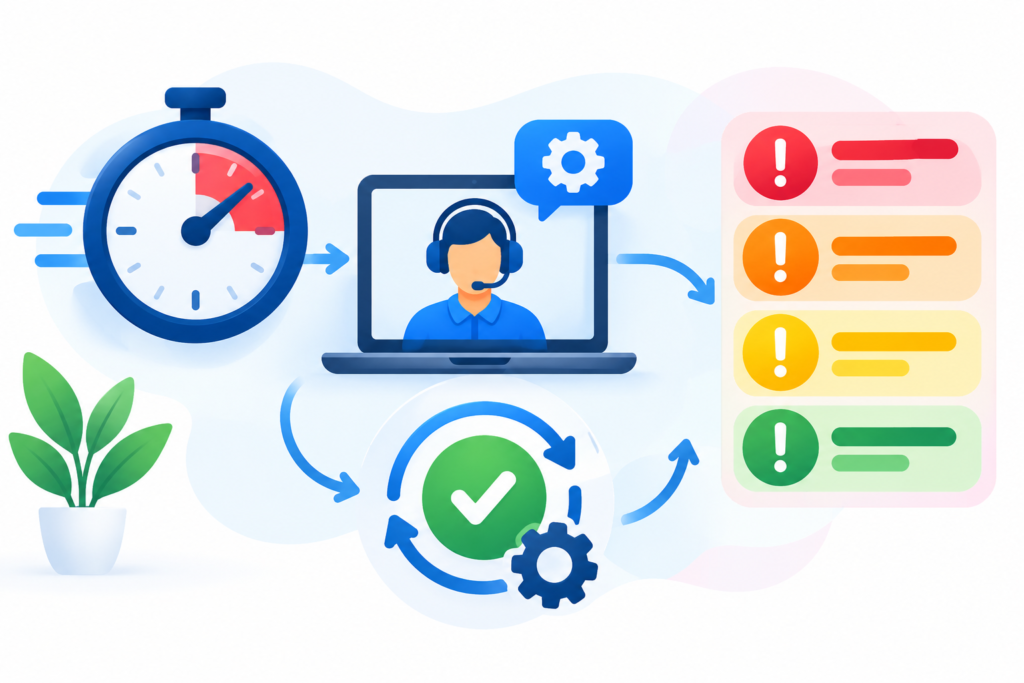
Response time and resolution time are two different concepts and should never be treated as identical.
Response time generally describes how quickly a provider acknowledges or begins handling an issue.
Resolution time refers to the time required to restore the affected service or provide an agreed solution.
A critical website outage may receive an immediate response while still requiring several hours of investigation before the underlying technical problem can be permanently resolved.
A well-written SLA should define both terms.
Incident priority is equally important.
A complete website outage should normally receive different treatment from a request to change a telephone number on a webpage.
A practical priority system could include:
Critical: Complete outage, severe security event, or major business-impacting failure.
High: Important functionality is significantly impaired.
Medium: A meaningful problem exists but a workaround is available.
Low: Routine requests, minor issues, information requests, or non-urgent changes.
Each category can have its own response target and escalation process.
The SLA should make it clear how priority is assigned.
Otherwise, every customer may classify their request as urgent, creating unnecessary pressure on support teams.
Businesses should also be careful about promising rigid resolution times.
Some incidents depend on third parties, customer approvals, security investigations, complex debugging, data recovery, or infrastructure changes.
For that reason, a responsible SLA may provide firm response commitments while establishing realistic resolution targets.
Communication is especially important during serious incidents.
If a critical problem cannot be resolved immediately, the customer should still receive useful updates.
A simple incident workflow can look like this:
- Incident reported
- Incident acknowledged
- Priority assigned
- Investigation started
- Customer updated
- Issue escalated where required
- Service restored
- Functionality verified
- Incident closed
- Post-incident review completed where appropriate
This creates consistency and gives the provider useful information for identifying recurring problems.
Website Hosting, Maintenance, and Technical Support SLAs
Website hosting and maintenance are particularly suitable for SLA-based service management because they involve recurring technical responsibilities.
A modern website may require monitoring, updates, security maintenance, backups, troubleshooting, performance checks, and technical support.
However, effective website support should not be reduced to simply keeping a server online.
A website can be technically hosted and still experience broken functionality, slow performance, security problems, outdated software, failed integrations, or poor user experience.
A comprehensive website SLA can therefore cover:
- Hosting availability
- Website monitoring
- Backup procedures
- Backup verification
- Software updates
- Security maintenance
- Malware investigation
- Technical troubleshooting
- Performance monitoring
- SSL/TLS configuration
- Domain-related support
- Incident management
- Scheduled maintenance
- Technical reporting
The SLA should also distinguish between proactive maintenance and reactive support.
Proactive maintenance attempts to prevent problems before they affect users.
Examples include software updates, monitoring, backup checks, security reviews, and performance optimisation.
Reactive support begins when an issue is detected or reported.
Examples include troubleshooting, incident investigation, emergency fixes, and service restoration.
Both approaches are important.
Website performance can also be incorporated into an SLA where appropriate.
Core Web Vitals provide measurable signals related to loading performance, interactivity, and visual stability, and Google provides documentation explaining how these metrics can be understood and measured. Core Web Vitals
However, an SLA should avoid guaranteeing identical performance for every visitor.
Performance can vary depending on devices, browsers, networks, locations, third-party resources, and other factors.
A provider can reasonably commit to monitoring, investigation, optimisation, and technical maintenance without promising an impossible universal result.
The same principle applies to security.
An SLA can define maintenance procedures, monitoring, updates, backup responsibilities, and incident escalation, but it should not suggest that a website can be made completely immune to every possible future security threat.
The strongest technical SLA focuses on repeatable processes, measurable commitments, realistic expectations, and continuous improvement.
Security, Backups, and Business Continuity in an SLA
Security should be treated as an operational responsibility rather than a vague statement that a website is “secure.”
A useful SLA should explain which security activities are included, who performs them, how incidents are reported, and how serious security events are escalated.
Depending on the service, security responsibilities may include software updates, vulnerability monitoring, malware investigation, access controls, SSL/TLS configuration, account protection, backup management, and incident response.
Backups require particular attention.
Simply stating that “backups are taken” does not provide enough information.
A stronger SLA should explain the expected backup frequency, retention period, storage method, restoration responsibility, and applicable recovery targets.
Backup verification is also important.
A backup that exists but cannot be restored successfully may provide much less protection than the customer expects.
For this reason, mature continuity planning should address both backup creation and restoration testing.
Website security should also include appropriate use of HTTPS.
Google’s technical documentation explains that moving from HTTP to HTTPS involves TLS certificates and other implementation considerations, particularly when changing site URLs or infrastructure. HTTPS
An SLA can convert these technical principles into practical responsibilities.
For example, the provider may agree to:
- Apply agreed security updates
- Monitor defined systems
- Investigate reported vulnerabilities
- Maintain agreed backup procedures
- Escalate suspected security incidents
- Support restoration procedures
- Maintain appropriate technical controls
- Document significant incidents
The customer may remain responsible for passwords, employee access, internal devices, third-party subscriptions, and systems outside the provider’s agreed scope.
Business continuity should also reflect the importance of the service.
For an e-commerce business, website downtime may stop transactions.
For a professional service business, downtime may prevent potential customers from submitting enquiries.
For a membership organisation, a failed portal could prevent customers from accessing essential information.
Two useful continuity concepts are:
Recovery Time Objective (RTO) — the target time for restoring a service after a disruption.
Recovery Point Objective (RPO) — the acceptable amount of data loss based on the available recovery point.
Including these concepts where appropriate can make an SLA considerably more useful.
The goal is not to eliminate every possible risk.
The goal is to establish clear responsibilities, appropriate controls, measurable recovery expectations, and dependable communication.
Monitoring, Performance Measurement, and SLA Reporting
An SLA becomes significantly more valuable when its commitments are supported by consistent monitoring and reporting.
Without measurement, service quality can become subjective.
A customer may believe support is too slow while the provider believes it has responded within the agreed target.
Reliable measurement creates evidence that both parties can review.
Depending on the service, useful metrics may include:
- Availability
- Incident volume
- Response time
- Resolution time
- Critical incidents
- Backup success
- Security events
- Planned maintenance
- Performance trends
- Recurring problems
- Support request categories
However, a report containing dozens of technical numbers is not automatically useful.
A strong SLA report should answer practical questions:
Did the service meet the agreed targets?
What incidents occurred?
How quickly were they handled?
Were any targets missed?
Why were they missed?
What corrective action is being taken?
Are there recurring issues?
This makes reporting useful to business owners and managers, not just technical teams.
Trend analysis can be particularly valuable.
One isolated incident may not indicate a major problem. Repeated incidents involving the same component can reveal an underlying issue.
For example, recurring outages may indicate infrastructure limitations. Repeated security warnings may indicate outdated software. Frequent support tickets about the same function may indicate a usability problem.
SLA reporting can therefore become a continuous-improvement tool.
Where website search performance is part of the broader service, businesses can also use Google Search Console to monitor search-related information and identify technical or indexing issues. Google Search Console
Performance investigation can also use PageSpeed Insights where appropriate to evaluate page performance and user experience signals. PageSpeed Insights
The important principle is to connect measurements with decisions.
A report should not simply say what happened.
It should help explain what happened, why it happened, what was done, and what should happen next.
That is what turns SLA reporting into useful service intelligence.
Managing SLA Escalation and Communication
A strong escalation process ensures that serious problems receive the appropriate level of attention without forcing every minor issue into an emergency workflow.
Escalation should begin with clear criteria.
The SLA should explain which circumstances require escalation, who can escalate an issue, which technical or management teams become involved, and how the customer is informed.
For example, a complete website outage may automatically move to a senior technical team, while a routine content request remains within normal support procedures.
Escalation may occur because an issue is technically complex, exceeds a defined response threshold, affects a large number of users, creates significant business impact, or involves a security concern.
Escalation should not automatically be treated as a failure.
In a mature service environment, escalation is simply a mechanism for ensuring that the correct resources become involved when necessary.
Communication is equally important.
Customers should know which channel to use for normal support and which method should be used for urgent incidents.
If an emergency is submitted through an unmonitored channel, the expected response time may become unrealistic.
An SLA can therefore define:
- Support email
- Ticketing system
- Emergency contact method
- Support hours
- Out-of-hours procedure
- Incident update frequency
- Escalation contacts
- Management escalation
- Security incident reporting
Communication should continue even when a third party is responsible for the underlying failure.
If an external hosting provider is experiencing an outage, the customer should still receive information about what is known, what has been escalated, and what actions are being taken.
This creates transparency.
The objective of escalation is not simply to solve problems faster.
It is to ensure that important incidents are managed consistently, communicated clearly, and documented properly.
Establishing Service Reviews and Continuous Improvement
An SLA should not be treated as a document that is written once and forgotten.
Technology changes.
Businesses grow.
Websites become more complex.
Traffic increases.
Security requirements evolve.
Third-party platforms change.
Customer expectations develop.
For these reasons, an effective SLA should include a service review process.
A review can examine:
- Availability performance
- Incident trends
- Response performance
- Resolution performance
- Security events
- Backup performance
- Recurring problems
- Planned improvements
- Business priorities
- Infrastructure changes
- Technical requirements
For example, a website that originally received limited traffic may eventually become a major source of revenue.
The original hosting arrangement and SLA may no longer provide sufficient capacity or support.
Similarly, a company may introduce e-commerce functionality, customer accounts, online booking, subscriptions, or other business-critical features.
Those changes may justify stronger service requirements.
Continuous improvement should be based on evidence.
If monitoring shows that the same type of incident occurs repeatedly, the provider should investigate the underlying cause rather than simply closing each ticket.
A useful improvement cycle is:
Plan → Implement → Measure → Review → Improve
This creates a repeatable method for improving service quality.
The SLA itself should also evolve.
A measurement that was useful when the agreement was created may become less important later.
The objective of review is therefore not to make the SLA longer.
It is to make the SLA more accurate and more useful.
How to Choose the Right SLA for Your Business
There is no universal SLA that is suitable for every organisation.
The right agreement depends on service importance, technical complexity, business risk, operating hours, customer expectations, provider capabilities, and budget.
Start by identifying how important the service is.
Ask what would happen if the website became unavailable for:
- 15 minutes
- 1 hour
- 4 hours
- 1 business day
- Several days
If the consequences include lost sales, lost leads, customer disruption, reputational damage, or operational problems, stronger service commitments may be appropriate.
Next, identify the most important services.
For a website environment, these may include hosting, availability, security, backups, technical maintenance, performance monitoring, and incident response.
Then establish measurable targets.
Avoid selecting targets simply because they sound impressive.
The provider should be capable of delivering them consistently.
The agreement should also define exclusions.
Third-party failures, unsupported software, customer-caused configuration changes, and circumstances outside the provider’s reasonable control may need specific treatment.
Another important consideration is search-related responsibility.
An SLA can define technical SEO tasks, monitoring, implementation, and reporting, but should avoid promising a specific ranking position.
Google’s documentation explains that websites should focus on technical requirements, helpful content, and avoiding spam practices rather than attempting to manipulate Search. Google Search Essentials
The right SLA therefore focuses on measurable responsibilities that the provider can reasonably control.
A Step-by-Step Process for Implementing a Service Level Agreement
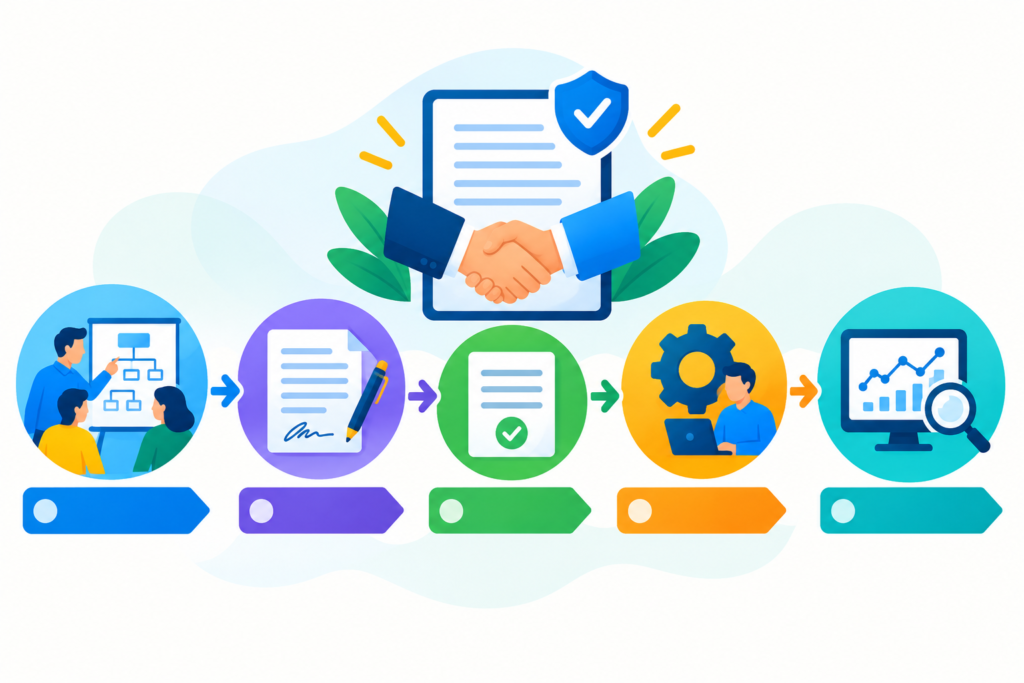
Implementing an SLA should begin with understanding the service rather than immediately writing contractual language.
Step 1: Identify the service
Document exactly what is being provided.
Step 2: Identify business priorities
Determine which services are most important and what happens if they fail.
Step 3: Define service levels
Establish measurable expectations for availability, response, resolution, maintenance, monitoring, and reporting.
Step 4: Establish incident priorities
Create clear definitions for critical, high, medium, and low-priority issues.
Step 5: Assign responsibilities
Document provider and customer responsibilities.
Step 6: Define exclusions
Identify third-party dependencies and circumstances outside the agreed scope.
Step 7: Establish communication channels
Specify where support requests should be submitted.
Step 8: Create escalation procedures
Define when technical or management escalation should occur.
Step 9: Implement monitoring
Use appropriate tools to measure availability, performance, security, backups, and support.
Step 10: Establish reporting
Create a simple reporting format that communicates useful information.
Step 11: Test the process
Test communication, escalation, backups, and restoration procedures where appropriate.
Step 12: Review the SLA
Compare actual performance against agreed targets.
Implementation should be treated as an operational process rather than paperwork.
The SLA needs supporting procedures, monitoring tools, responsible personnel, communication channels, and documented ownership.
For website-related services, technical practices should also be reviewed periodically because Google’s search documentation changes over time. Its published Google Search updates provide a useful reference for tracking changes to Search documentation and guidance. Google Search updates
Common Mistakes Businesses Make When Creating SLAs
One of the biggest SLA mistakes is using vague language.
Statements such as “fast support,” “excellent uptime,” or “regular maintenance” cannot be measured consistently.
Another common mistake is promising unrealistic resolution times.
Some incidents depend on third-party providers, customer approvals, security investigations, data recovery, or complex technical troubleshooting.
A third mistake is failing to define exclusions.
A fourth mistake is treating uptime as the only important performance measurement.
A website can remain online while experiencing serious performance, security, functionality, or usability problems.
A fifth mistake is ignoring customer responsibilities.
If a provider needs customer approval before making a change, the SLA should explain how delays affect the service timeline.
A sixth mistake is creating reports containing too much data and too little insight.
A seventh mistake is failing to update the SLA as the business changes.
Another serious mistake is treating an SLA as a marketing document rather than an operational framework.
The agreement should not promise everything.
It should define what can genuinely be delivered.
Businesses should also avoid using manipulative SEO promises as SLA commitments. Google’s Spam Policies explain practices that can violate its Search guidelines and potentially result in reduced visibility. Spam Policies
A strong SLA is ultimately built around clarity, evidence, realistic expectations, and accountability.
Best Practices Summary for Building an Effective SLA
The strongest Service Level Agreements share several important characteristics.
First, they are specific.
They clearly define what is included, what is measured, who is responsible, and what happens when a service target is missed.
Second, they are measurable.
Availability, response time, resolution time, backup success, and incident frequency should have clear definitions.
Third, they are realistic.
Providers should not promise results that depend entirely on third parties or factors outside their control.
Fourth, they are business-focused.
Service levels should reflect the actual impact of technical failures on the organisation.
Fifth, they are transparent.
Customers should understand how performance is measured.
Sixth, they provide clear escalation procedures.
Serious incidents should receive the appropriate level of attention.
Seventh, they include regular reporting.
Service information should be converted into useful insights.
Eighth, they support continuous improvement.
Recurring problems should result in investigation and corrective action.
Ninth, they define security and backup responsibilities.
Security should never be left as a vague promise.
Tenth, they remain current.
An SLA should evolve when the business, technology, infrastructure, or service requirements change.
Technical standards should also be handled responsibly.
For example, Google’s documentation provides guidance around structured data and how websites can use structured data to help Google understand page content. structured data
An SLA should therefore focus on responsible implementation rather than guaranteeing search results.
The strongest agreement is not necessarily the longest one.
It is the agreement that both parties can understand, measure, operate, review, and trust.
Frequently Asked Questions
What is the main purpose of a Service Level Agreement?
The primary purpose of a Service Level Agreement is to establish clear and measurable expectations between a service provider and customer.
It explains what is being provided, how performance is measured, who is responsible for different activities, and how incidents are handled.
What should a Service Level Agreement include?
An SLA can include service scope, availability targets, support hours, response times, resolution targets, incident priorities, maintenance responsibilities, security procedures, backup requirements, monitoring, reporting, escalation, exclusions, customer responsibilities, and review procedures.
Is uptime the most important SLA metric?
Not necessarily.
Uptime is important for many services, but it is only one aspect of service quality.
Performance, security, backup reliability, response time, resolution time, and incident frequency can also be important.
What is the difference between response time and resolution time?
Response time describes how quickly a provider acknowledges or begins handling an issue.
Resolution time describes how long it takes to restore the affected service or provide an agreed solution.
Should an SLA guarantee a Google ranking?
No.
Search rankings depend on many factors outside a provider’s direct control.
An SLA can instead define measurable technical SEO responsibilities such as implementation, monitoring, technical improvements, and reporting.
How often should an SLA be reviewed?
The appropriate frequency depends on the service.
Businesses should review SLAs regularly and whenever there are major changes to infrastructure, business priorities, traffic, security requirements, or service scope.
Can security responsibilities be included in an SLA?
Yes.
An SLA can define software updates, security monitoring, backup procedures, incident escalation, access controls, malware investigation, and recovery support.
What happens when an SLA target is missed?
The SLA should explain the appropriate response.
Depending on the agreement, this might involve incident review, escalation, corrective action, reporting, service credits, or another agreed remedy.
Conclusion
A Service Level Agreement is much more than a contractual document. When designed correctly, it becomes a practical framework for accountability, transparency, measurable service quality, reliable communication, and continuous improvement. A strong SLA clearly defines service scope, establishes realistic expectations, identifies responsibilities, measures meaningful performance, explains incident priorities, and provides a structured escalation process. For website services, these principles are particularly important because modern websites depend on multiple connected systems. Hosting, backups, security, software updates, monitoring, performance, third-party integrations, and technical support can all affect the overall service experience. A properly structured SLA brings these responsibilities together. It also gives businesses a way to evaluate service performance using evidence rather than assumptions. When availability is measured, response times are tracked, incidents are documented, backups are monitored, and recurring problems are analysed, service management becomes much more predictable. The goal is not to create the longest possible SLA. The goal is to create an agreement that is specific, measurable, realistic, transparent, business-focused, and operationally achievable. That approach creates a stronger foundation for dependable digital services and long-term provider-customer relationships.
Want to Implement This Easily?
You are an expert consultant. Based on the blog post titled “(Service Level Agreements)”, provide a step-by-step, practical implementation guide. Include tools, best practices, common mistakes to avoid, and advanced tips. Assume the reader wants to implement everything discussed in this article effectively.
Want our help implementing this? Just reach out to us via our website contact form: contact form