

Discover advanced Social Media strategies for business growth in 2026. Learn content marketing, audience engagement, platform optimization, analytics, branding, and conversion-focused social campaigns for long-term success.
Introduction
Social Media has evolved from a simple communication channel into one of the most influential digital marketing ecosystems for businesses of every size. Whether a company wants to build authority, generate leads, increase sales, improve customer relationships, or strengthen brand visibility, a well-executed social strategy can deliver measurable results. In today’s competitive online environment, businesses that fail to invest in strategic social engagement often struggle to maintain visibility and customer trust.
Modern consumers expect brands to be accessible, responsive, educational, and engaging across multiple platforms. From short-form video content to community-driven discussions, social platforms now influence purchasing decisions at nearly every stage of the buyer journey. Successful businesses understand that social media marketing is no longer optional — it is an essential component of sustainable digital growth. Companies using intelligent platform strategies often experience stronger customer retention, better audience insights, and increased online authority.
At Monthly Website Design, businesses increasingly recognize the importance of combining professional website experiences with powerful social engagement strategies. When social campaigns work alongside optimized websites, SEO initiatives, and conversion-focused content, brands create a unified digital presence capable of attracting and retaining high-quality customers in competitive industries.
Understanding the Role of Social Media in Modern Digital Marketing
Social Media has become deeply integrated into modern digital marketing strategies because it enables direct interaction between brands and consumers. Unlike traditional advertising methods, social platforms allow businesses to communicate in real time, respond instantly, and build long-term customer relationships. Platforms such as Facebook, Instagram, LinkedIn, TikTok, and YouTube each serve different audience behaviors and marketing objectives, making platform selection critically important.
Businesses that understand user intent across social channels can create more targeted and personalized campaigns. For example, visual storytelling performs exceptionally well on Instagram, while professional thought leadership gains more traction on LinkedIn. Educational long-form videos thrive on YouTube, whereas viral entertainment content spreads rapidly on TikTok. Effective marketers analyze audience psychology and platform algorithms to tailor content formats for maximum engagement and reach.
Another major advantage of social media marketing is data accessibility. Platforms provide valuable insights into demographics, engagement patterns, conversion rates, audience interests, and campaign performance. This data-driven environment allows businesses to optimize strategies continuously. According to Google Search Central best practices, businesses should focus on creating valuable, people-first content rather than relying on manipulative tactics. Social platforms reward authenticity, consistency, and meaningful engagement, which aligns closely with modern search quality principles.
Why Brand Authority Matters on Social Media
Brand authority is one of the strongest competitive advantages a business can develop online. Social media platforms provide companies with opportunities to establish expertise, demonstrate trustworthiness, and position themselves as reliable industry leaders. Businesses with strong social authority typically experience improved customer loyalty, increased referrals, and higher conversion rates because audiences naturally trust recognizable and respected brands.
Authority is built through consistency, educational content, and audience engagement. Brands that regularly publish helpful insights, practical solutions, and industry expertise gradually become trusted information sources. This trust often extends beyond social platforms into search engine visibility, customer retention, and business reputation. Consumers increasingly research businesses online before making purchasing decisions, meaning inactive or poorly managed social accounts can negatively impact credibility.
Thought leadership content plays a major role in authority development. Businesses that share original perspectives, industry commentary, trend analysis, case studies, and expert guidance often gain stronger audience engagement. High-quality visual branding, professional communication, and transparent interactions further reinforce credibility. Additionally, user-generated content, customer testimonials, and authentic reviews can significantly enhance perceived trustworthiness.
Social proof is one of the most powerful psychological drivers in digital marketing. When users see active communities, positive engagement, and satisfied customers interacting with a brand, they are more likely to trust that business themselves. Companies that prioritize long-term audience relationships over short-term vanity metrics generally build stronger and more sustainable authority online.
Choosing the Right Social Media Platforms for Your Business
Not every platform is suitable for every business model. One of the most common mistakes companies make is trying to dominate every social network simultaneously without understanding where their ideal customers spend time. Strategic platform selection allows businesses to focus resources effectively while maximizing engagement and conversions.
Businesses targeting younger demographics often achieve strong results on TikTok and Instagram due to their highly visual and entertainment-focused ecosystems. B2B companies, consultants, and professional service providers usually benefit more from LinkedIn because it supports professional networking, educational content, and authority positioning. Meanwhile, Facebook continues to perform well for local communities, advertising campaigns, and audience retargeting.
Understanding audience intent is essential when selecting platforms. Consumers use different social networks for different reasons. Someone browsing LinkedIn may be looking for industry insights or professional solutions, while a TikTok user may prioritize entertainment and quick educational clips. Businesses that align their content strategy with platform behavior tend to achieve better reach and stronger engagement metrics.
Companies should also evaluate platform capabilities, advertising options, analytics tools, and organic growth potential. For example, YouTube offers long-term search visibility because videos continue generating traffic over time. Instagram Stories support short-lived engagement opportunities, while Facebook Groups encourage community building. Businesses should avoid copying identical content across every platform without adaptation, as audiences respond differently depending on the environment and content format.
Building a Results-Driven Social Media Strategy
A successful social media strategy requires far more than posting content randomly. Businesses need clearly defined goals, audience research, performance metrics, and structured campaign planning. Without strategic direction, even visually appealing content can fail to produce measurable business outcomes.
The first step in strategy development involves identifying primary objectives. Some businesses prioritize brand awareness, while others focus on lead generation, customer retention, sales conversions, or community growth. Each objective requires different content formats, messaging approaches, and performance indicators. Establishing measurable goals enables businesses to evaluate campaign effectiveness accurately.
Audience research is equally important. Brands should analyze demographics, interests, behavioral patterns, purchasing motivations, and common challenges. Understanding audience pain points allows businesses to create highly relevant content that resonates emotionally and practically. Personalized messaging often performs significantly better than generic promotional material because audiences prefer brands that understand their needs.
A strong strategy also includes content calendars, posting consistency, campaign themes, and performance analysis. Businesses should combine organic content with paid advertising for optimal reach and scalability. Integrating social media with email marketing, SEO, website optimization, and conversion tracking creates a more comprehensive digital ecosystem. According to Google Analytics best practices, businesses should continuously analyze user behavior and engagement data to refine digital marketing performance effectively.
The Importance of Content Marketing in Social Media Success

Content is the foundation of successful social media marketing because it determines how audiences perceive, interact with, and remember a brand. High-quality content educates, entertains, inspires, and builds emotional connections with users. Businesses that consistently create valuable content often experience stronger organic reach and audience loyalty over time.
Modern audiences are overwhelmed by promotional messaging. As a result, businesses that focus entirely on direct sales pitches often struggle to maintain engagement. Educational and value-driven content performs better because it addresses user needs before asking for conversions. Tutorials, behind-the-scenes insights, industry trends, case studies, and practical advice all help strengthen audience relationships.
Video content continues to dominate social engagement across multiple platforms. Short-form videos, live streams, interviews, webinars, and educational clips typically generate higher interaction rates compared to static posts. Visual storytelling captures attention quickly and encourages users to spend more time interacting with brand content. Additionally, interactive content such as polls, Q&A sessions, and user challenges can significantly improve community participation.
Consistency is another critical factor in content marketing success. Brands that publish regularly remain visible within platform algorithms and audience feeds. However, consistency should never compromise quality. Businesses should focus on creating meaningful content aligned with their audience’s interests and needs. Quality-driven content strategies generally outperform high-volume posting schedules that lack substance or originality.
How Social Media Algorithms Influence Visibility
Understanding social media algorithms is essential for businesses that want to maximize organic reach and engagement. Algorithms determine which content appears in user feeds based on factors such as relevance, engagement, watch time, interactions, consistency, and content quality. Businesses that understand these ranking systems can optimize their strategies for improved visibility.
Most platforms prioritize content that generates meaningful engagement. Likes, comments, shares, saves, watch duration, and direct interactions all signal value to the algorithm. Content that encourages conversations and audience participation often performs significantly better than passive promotional posts. Platforms aim to keep users engaged, so they reward content that retains attention and stimulates interaction.
Video watch time has become especially important across platforms like TikTok, Instagram Reels, YouTube Shorts, and Facebook video feeds. The longer users watch content, the stronger the engagement signal becomes. Businesses that create compelling introductions, emotional storytelling, and visually engaging sequences often experience better algorithmic distribution.
Consistency also plays a major role in algorithm performance. Regular posting schedules help platforms understand content patterns and audience relevance. However, engagement quality remains more important than posting frequency alone. Businesses should focus on audience satisfaction, authenticity, and value rather than attempting to manipulate algorithms through spam-like behavior or excessive hashtags.
Modern algorithms increasingly prioritize user experience and content quality. This aligns closely with recommendations from Google Search Essentials, which emphasize helpful, people-first content over manipulative optimization tactics. Brands that genuinely serve audience interests tend to achieve stronger long-term visibility.
Creating Engaging Visual Content for Social Media
Visual content has become one of the most influential components of successful social media marketing. Users process visuals significantly faster than text, making imagery and video essential for capturing attention in crowded digital feeds. Businesses that invest in strong visual branding often create more memorable and recognizable online identities.
Professional design consistency helps reinforce brand identity across platforms. Elements such as typography, colors, imagery style, and visual themes should remain cohesive to strengthen recognition and trust. Audiences are more likely to engage with brands that appear polished, organized, and visually appealing. However, authenticity remains equally important, especially in environments where overly polished content may feel less relatable.
Short-form video content continues to dominate audience engagement trends. Reels, Shorts, Stories, and TikTok videos allow businesses to communicate messages quickly while maintaining audience interest. Educational micro-content, product demonstrations, customer testimonials, and storytelling sequences often perform exceptionally well because they combine entertainment with practical value.
Businesses should also optimize visuals for platform-specific behavior. Vertical videos work best for mobile-first platforms, while longer educational content performs better on YouTube. Image carousels encourage interaction and longer engagement durations on Instagram and LinkedIn. Infographics can simplify complex information while increasing shareability. Effective visual strategies combine creativity, clarity, and audience relevance to maximize impact.
Audience Engagement and Community Building Strategies
Audience engagement is one of the defining characteristics that separates social media from traditional advertising. Successful brands do not simply broadcast messages; they create conversations, encourage participation, and build communities around shared interests and values. Community-driven marketing often produces stronger customer loyalty and higher long-term retention rates.
Responding to comments, messages, and customer feedback demonstrates accessibility and authenticity. Audiences appreciate businesses that actively participate in conversations rather than ignoring user interactions. Prompt communication also improves customer satisfaction and strengthens brand trust. Businesses that consistently engage with their audiences often build deeper emotional connections over time.
Community-building strategies can include live streams, Q&A sessions, user-generated campaigns, discussion groups, interactive polls, and collaborative content initiatives. Encouraging customers to share experiences, reviews, and success stories increases authenticity while expanding reach organically. User-generated content also acts as social proof, influencing purchasing decisions through peer validation.
Strong communities create long-term marketing advantages because engaged audiences often become brand advocates. Loyal followers voluntarily share content, recommend services, and defend brand reputation during public discussions. This level of advocacy cannot be achieved through advertising alone; it develops through trust, consistency, and meaningful interaction. Businesses that prioritize relationship-building over constant promotion often experience stronger sustainable growth across social platforms.
Using Influencer Marketing Effectively
Influencer marketing has become a major component of modern social media strategies because audiences increasingly trust recommendations from creators they follow. However, effective influencer partnerships require careful planning, audience alignment, and authenticity. Businesses that select influencers purely based on follower count often experience disappointing results.
Micro-influencers frequently outperform larger influencers in terms of engagement quality and audience trust. Their communities are often more targeted, loyal, and responsive. Businesses should evaluate audience demographics, engagement authenticity, content quality, and niche relevance before selecting partnerships. A smaller creator with strong credibility in a specific industry can deliver more valuable conversions than a celebrity influencer with a broad but disengaged audience.
Successful influencer campaigns focus on authentic collaboration rather than scripted advertising. Audiences can easily detect forced promotions, which may reduce trust in both the influencer and the brand. Allowing creators creative flexibility often produces more natural and engaging content. Businesses should prioritize long-term partnerships instead of one-time promotions whenever possible.
Transparency is also essential for maintaining trust. Sponsored content disclosures help ensure ethical marketing practices and regulatory compliance. According to Federal Trade Commission Guidelines, influencer partnerships should clearly disclose paid relationships to maintain transparency with consumers. Ethical influencer marketing strengthens credibility while reducing reputational risk.
Social Media Advertising and Paid Campaign Optimization
Organic reach alone is often insufficient for businesses seeking rapid growth or highly targeted customer acquisition. Social media advertising allows brands to reach specific demographics, retarget website visitors, and scale campaigns efficiently. Platforms provide advanced targeting capabilities that enable businesses to reach users based on interests, behaviors, demographics, and purchasing intent.
Facebook and Instagram advertising remain highly effective for audience targeting and conversion campaigns. LinkedIn Ads work particularly well for B2B lead generation and professional services, while TikTok Ads excel in brand awareness and viral engagement campaigns. YouTube advertising offers strong visibility for educational and product-focused video content. Each platform provides unique advantages depending on business goals and audience behavior.
Successful advertising campaigns require compelling creatives, persuasive messaging, and optimized landing experiences. Businesses should continuously test headlines, visuals, calls to action, and audience segments to improve campaign performance. A/B testing helps identify high-performing combinations while reducing wasted advertising spend. Campaign optimization is an ongoing process rather than a one-time setup.
Retargeting strategies can significantly improve conversion rates by reconnecting with users who previously interacted with a business. Visitors who viewed products, watched videos, or engaged with content often convert at higher rates when exposed to follow-up campaigns. Integrating advertising data with website analytics helps businesses measure ROI more accurately and refine future marketing decisions.
Social Media Analytics and Performance Tracking
One of the greatest advantages of digital marketing is the ability to measure performance in real time. Social media analytics provide businesses with valuable insights into audience behavior, campaign effectiveness, engagement trends, and conversion opportunities. Companies that actively analyze performance data are more likely to improve results consistently over time.
Key performance indicators vary depending on campaign objectives. Businesses focused on awareness may prioritize reach, impressions, and follower growth, while conversion-focused campaigns may emphasize click-through rates, lead generation, or sales revenue. Engagement metrics such as comments, shares, saves, and watch duration provide deeper insights into content quality and audience interest.
Analytics also help businesses identify content patterns and audience preferences. By analyzing top-performing posts, brands can refine future content strategies based on real user behavior rather than assumptions. Performance tracking enables businesses to allocate resources more effectively while improving ROI across campaigns.
Modern analytics tools provide increasingly sophisticated insights. Platforms such as Meta Business Suite, Google Analytics, and YouTube Studio allow businesses to monitor traffic sources, audience retention, engagement trends, and conversion paths. Data-driven decision-making enables brands to improve efficiency while minimizing ineffective marketing activities.
Social Media and Search Engine Optimization Integration
Although social media signals are not direct ranking factors in traditional search algorithms, social platforms strongly influence overall SEO performance. Businesses that integrate social media with SEO strategies often improve brand visibility, traffic generation, backlink opportunities, and content discovery. Social content can amplify reach while supporting broader digital marketing objectives.
Social sharing increases exposure for blog articles, videos, case studies, and educational resources. When high-quality content gains traction on social platforms, it may attract backlinks, mentions, and referral traffic from other websites. Increased visibility can indirectly support stronger organic search performance over time. Businesses that create shareable and informative content often expand their online authority across multiple channels.
Brand searches also play an important role in modern SEO ecosystems. Strong social media presence increases brand recognition, which can lead to more branded search queries. Search engines increasingly evaluate overall brand credibility and online reputation when assessing content quality and authority. Active social engagement contributes positively to perceived trustworthiness.
Technical optimization remains essential for integrated digital performance. Businesses should ensure landing pages load quickly, function properly on mobile devices, and provide seamless user experiences. According to Google PageSpeed Insights recommendations, fast-loading pages improve both user satisfaction and overall performance outcomes. Combining technical SEO with strategic social promotion creates a stronger and more sustainable digital presence.
Social Media Trends Shaping Digital Marketing in 2026
Social Media trends evolve rapidly, and businesses that adapt early often gain significant competitive advantages. In 2026, platforms are increasingly prioritizing authentic engagement, short-form video experiences, AI-enhanced personalization, and community-driven interactions. Brands that fail to adjust to changing user behavior may experience declining reach and weaker audience engagement over time.
One of the most influential trends is the continued dominance of short-form video content. Users prefer fast, visually engaging, and highly informative videos that deliver value quickly. Platforms are heavily investing in algorithmic systems that prioritize retention and watch time, making storytelling structure more important than ever. Businesses that create compelling introductions, emotionally engaging narratives, and practical educational clips are seeing stronger organic distribution and higher audience interaction rates.
Another major development involves AI-powered content personalization. Social platforms increasingly tailor user feeds according to behavior patterns, interests, engagement history, and predictive analytics. This means businesses must focus on relevance and audience-specific content rather than generic mass marketing. Hyper-targeted campaigns often outperform broad messaging because they align more effectively with user intent and preferences.
Community-based engagement is also becoming increasingly valuable. Private groups, exclusive communities, interactive memberships, and direct audience participation are helping brands build deeper relationships with users. Consumers are seeking more authentic online experiences and often prefer smaller niche communities over massive impersonal audiences. Businesses that prioritize meaningful interactions instead of vanity metrics are likely to experience stronger long-term brand loyalty.
Common Social Media Mistakes Businesses Should Avoid
Many businesses struggle with social media performance not because the platforms are ineffective, but because of avoidable strategic mistakes. Understanding these common errors can help companies improve engagement, strengthen brand trust, and maximize return on investment.
One of the most frequent mistakes is inconsistent posting. Businesses often start enthusiastically but fail to maintain regular content schedules. Inconsistency reduces visibility, weakens audience trust, and negatively impacts algorithmic performance. However, consistency does not mean posting excessive low-quality content. A smaller volume of high-value content usually outperforms frequent generic updates.
Another major issue is excessive self-promotion. Social media users generally avoid brands that constantly push sales messages without offering educational or entertaining value. Businesses that focus exclusively on promotions often experience declining engagement because audiences feel they are being advertised to rather than helped. Effective social strategies balance promotional content with useful insights, storytelling, and community engagement.
Ignoring analytics is another serious mistake. Some businesses continue repeating ineffective strategies without reviewing performance data. Social media analytics provide valuable insights into user behavior, engagement trends, audience demographics, and campaign results. Companies that fail to analyze data may waste resources on ineffective content formats or unsuitable platforms.
Poor audience engagement can also damage brand reputation. Users expect businesses to respond to questions, comments, and concerns promptly. Brands that ignore interactions often appear unprofessional or inaccessible. Responsive communication is a major trust factor in modern digital marketing. Businesses that actively engage with followers usually build stronger customer relationships and higher audience loyalty.
Social Commerce and Conversion-Focused Marketing
Social commerce has transformed how consumers discover and purchase products online. Platforms now integrate shopping experiences directly into user feeds, reducing friction between discovery and conversion. Businesses that optimize social commerce strategies can increase revenue while creating more seamless customer experiences.
Features such as Instagram Shops, Facebook Marketplace, TikTok Shop, and Pinterest Product Pins allow businesses to showcase products directly within social ecosystems. These tools reduce the number of steps required for customers to make purchasing decisions. Consumers increasingly expect convenience, speed, and mobile-friendly shopping experiences when interacting with brands online.
Conversion-focused social strategies require more than simply displaying products. Businesses must understand customer psychology, emotional triggers, and decision-making behaviors. High-converting campaigns typically combine persuasive visuals, social proof, compelling calls to action, and trust-building elements. Customer testimonials, reviews, before-and-after examples, and real-world demonstrations often improve conversion performance significantly.
Retargeting campaigns are particularly effective within social commerce ecosystems. Many users do not purchase immediately after first exposure. Retargeting allows businesses to reconnect with interested users through follow-up content, reminders, or personalized offers. Businesses that implement multi-stage conversion funnels often achieve stronger ROI compared to single-interaction campaigns.
Additionally, mobile optimization is essential for social commerce success. Most social browsing occurs on mobile devices, meaning businesses must ensure landing pages load quickly and provide frictionless navigation. According to Google Mobile-Friendly Test recommendations, optimized mobile experiences improve user satisfaction and conversion opportunities substantially.
Video Marketing and Live Streaming Strategies
Video marketing continues to dominate social media engagement because it combines visual storytelling, emotional connection, and educational value in highly digestible formats. Businesses that integrate video into their marketing strategies often experience stronger audience retention, increased trust, and improved conversion rates.
Short-form video content performs particularly well because it aligns with modern attention spans and mobile consumption habits. Educational tips, product tutorials, behind-the-scenes content, interviews, customer success stories, and industry commentary all provide opportunities for engaging video campaigns. Effective videos capture attention quickly and communicate value within the first few seconds.
Live streaming has also become increasingly valuable for real-time audience engagement. Live broadcasts create immediacy and authenticity that prerecorded content sometimes lacks. Businesses can use live sessions for Q&A discussions, webinars, product launches, tutorials, interviews, and community engagement events. Real-time interaction helps strengthen audience trust while encouraging active participation.
Authenticity is one of the most important factors in successful video marketing. Audiences increasingly prefer relatable and transparent content over heavily scripted advertising. Businesses that appear approachable and human often build stronger emotional connections with viewers. This does not mean quality should be ignored; rather, authenticity and professionalism should work together.
Long-form video platforms such as YouTube continue providing long-term visibility advantages because videos remain searchable for extended periods. Educational evergreen content can generate traffic and leads months or even years after publication. Businesses that combine short-form discoverability with long-form educational authority often create highly effective video ecosystems.
Reputation Management and Crisis Communication on Social Media
A brand’s online reputation can significantly influence customer trust, purchasing decisions, and long-term business success. Social media amplifies both positive and negative experiences rapidly, making reputation management an essential component of digital marketing strategies.
Businesses should monitor brand mentions, customer feedback, reviews, and online discussions consistently. Early identification of potential issues allows companies to respond before problems escalate publicly. Social listening tools help businesses track audience sentiment and understand how their brand is perceived online.
Effective crisis communication requires transparency, professionalism, and timely responses. Attempting to ignore legitimate concerns or delete criticism without explanation often damages trust further. Customers generally appreciate businesses that acknowledge mistakes honestly and provide clear solutions. Calm, respectful communication is especially important during public disputes or negative publicity situations.
Positive reputation management also involves proactive trust-building. Businesses should encourage satisfied customers to leave reviews, share testimonials, and participate in user-generated campaigns. Consistent customer support, transparent policies, and reliable communication help strengthen brand credibility over time.
Security and account protection are equally important in reputation management. Compromised accounts can damage brand trust quickly if unauthorized content is published. Following recommendations from Google Account Security and enabling multi-factor authentication can help businesses reduce cybersecurity risks associated with social media management.
Artificial Intelligence and Automation in Social Media Marketing
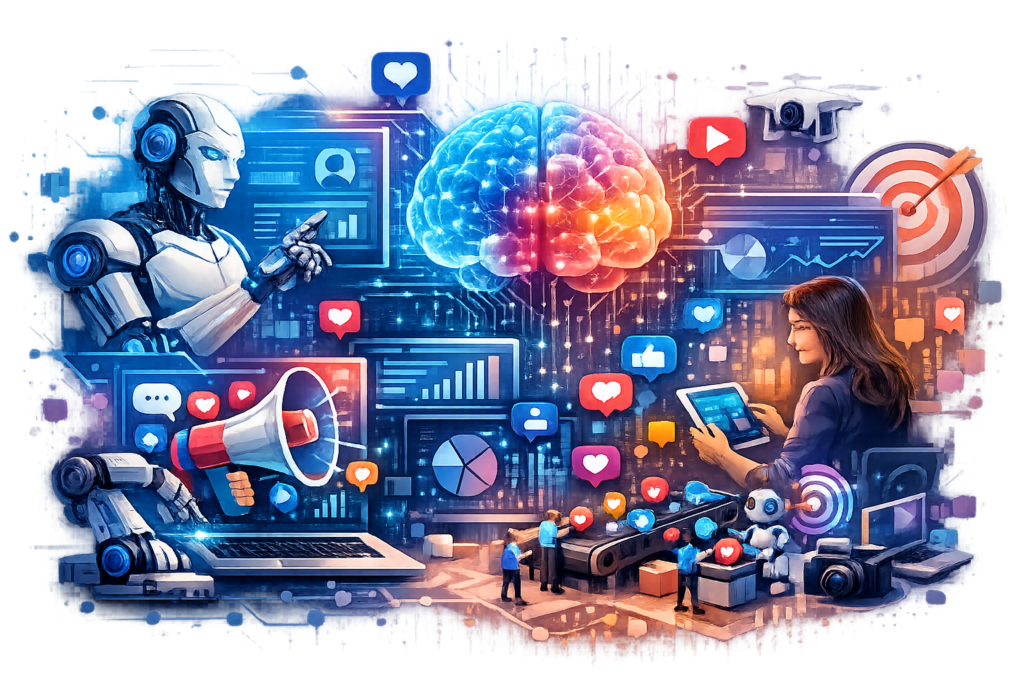
Artificial Intelligence is transforming social media marketing by improving efficiency, personalization, analytics, and campaign optimization. Businesses are increasingly using AI-powered tools to automate repetitive tasks, analyze audience behavior, and enhance content strategies.
AI can assist with content scheduling, hashtag research, sentiment analysis, audience segmentation, and predictive performance forecasting. Automation tools help businesses maintain consistency while reducing manual workload. However, automation should support human creativity rather than replace authentic communication entirely.
Chatbots and AI-driven customer support systems are becoming more sophisticated across social platforms. Businesses can provide faster responses to common customer inquiries while improving user experiences. Automated workflows can assist with appointment scheduling, lead qualification, and customer service routing, allowing teams to focus on more complex interactions.
AI-generated analytics also help marketers make more informed decisions. Advanced algorithms can identify trends, predict engagement opportunities, and recommend optimization strategies based on historical data. Businesses that combine AI insights with human strategic thinking often achieve stronger campaign performance.
Despite these advantages, over-reliance on automation can reduce authenticity. Audiences still value genuine interactions, emotional intelligence, and personalized engagement. The most effective social strategies combine technological efficiency with human-centered communication. Businesses should use AI responsibly while maintaining transparency and audience trust.
Best Practices Summary for Long-Term Social Media Success
Long-term success in social media marketing requires consistency, adaptability, and audience-focused strategies. Businesses that prioritize trust, value, and authentic communication generally outperform those relying on short-term tactics or manipulative growth methods.
The first best practice is maintaining consistent brand identity across all platforms. Visual design, messaging tone, content quality, and customer interactions should align with the company’s broader brand positioning. Consistency helps audiences recognize and trust the business more easily.
Audience-first content creation is equally important. Successful businesses focus on solving problems, answering questions, and delivering meaningful experiences rather than constantly promoting products. Educational, entertaining, and emotionally engaging content typically performs better than repetitive advertising campaigns.
Data analysis should remain a continuous process. Businesses should regularly evaluate analytics, test new formats, monitor audience behavior, and optimize campaigns accordingly. Digital marketing environments evolve rapidly, meaning adaptability is essential for sustained growth.
Strong community engagement is another critical factor. Brands that actively participate in conversations, acknowledge feedback, and encourage audience involvement often build stronger loyalty. Genuine relationships create long-term advocates who help amplify brand visibility organically.
Finally, businesses should integrate social media with broader digital marketing strategies. Combining SEO, content marketing, website optimization, email campaigns, and social engagement creates a unified ecosystem capable of driving sustainable traffic, leads, and conversions.
Frequently Asked Questions
What is the primary purpose of social media marketing?
The primary purpose of social media marketing is to build brand awareness, engage audiences, generate leads, increase conversions, and strengthen customer relationships through digital platforms. Effective strategies combine valuable content, audience engagement, and targeted promotion.
Which social media platform is best for businesses?
The best platform depends on the target audience and business goals. LinkedIn is often ideal for B2B marketing, Instagram works well for visual branding, TikTok excels in short-form engagement, and Facebook remains valuable for community building and advertising campaigns.
How often should businesses post on social media?
Posting frequency depends on platform behavior and audience expectations. Consistency is generally more important than volume. Businesses should focus on maintaining regular schedules while prioritizing quality and audience relevance.
Is paid advertising necessary for social media success?
Organic strategies can build strong communities, but paid advertising helps businesses scale reach, target specific demographics, and accelerate growth. Combining organic engagement with strategic advertising usually produces the best results.
How can businesses increase engagement on social media?
Businesses can improve engagement by creating valuable content, responding to comments, encouraging conversations, using interactive features, posting videos, and understanding audience interests and behaviors.
Does social media help SEO performance?
While social signals are not direct ranking factors, social media supports SEO indirectly by increasing content visibility, driving traffic, attracting backlinks, improving brand recognition, and expanding audience reach.
What type of content performs best on social media?
Video content, educational posts, storytelling campaigns, interactive content, customer testimonials, and visually engaging formats generally perform well across most platforms.
How important are analytics in social media marketing?
Analytics are extremely important because they help businesses understand audience behavior, measure campaign performance, identify trends, and optimize future strategies based on real data.
Conclusion
Social Media continues to shape the future of digital marketing by influencing how businesses communicate, engage, and build trust with audiences worldwide. Companies that prioritize authentic engagement, strategic content creation, audience understanding, and data-driven optimization are better positioned to achieve sustainable long-term growth in increasingly competitive online environments.
The most successful brands understand that social media is not simply about gaining followers or generating likes. It is about building meaningful relationships, creating valuable experiences, and developing lasting customer trust. Businesses that combine creativity, consistency, technical optimization, and customer-focused communication often achieve stronger visibility, higher engagement, and improved conversions across digital channels.
At Monthly Website Design, businesses can develop integrated digital strategies that combine professional web experiences with high-performance social media marketing approaches designed for modern online growth and long-term brand success.
Want to Implement This Easily?
Prompt Text:
You are an expert consultant. Based on the blog post titled “Social Media”, provide a step-by-step, practical implementation guide. Include tools, best practices, common mistakes to avoid, and advanced tips. Assume the reader wants to implement everything discussed in this article effectively.
Call to Action:
Want our help implementing this? Just reach out to us via our website contact form:
Monthly Website Design Contact Form