
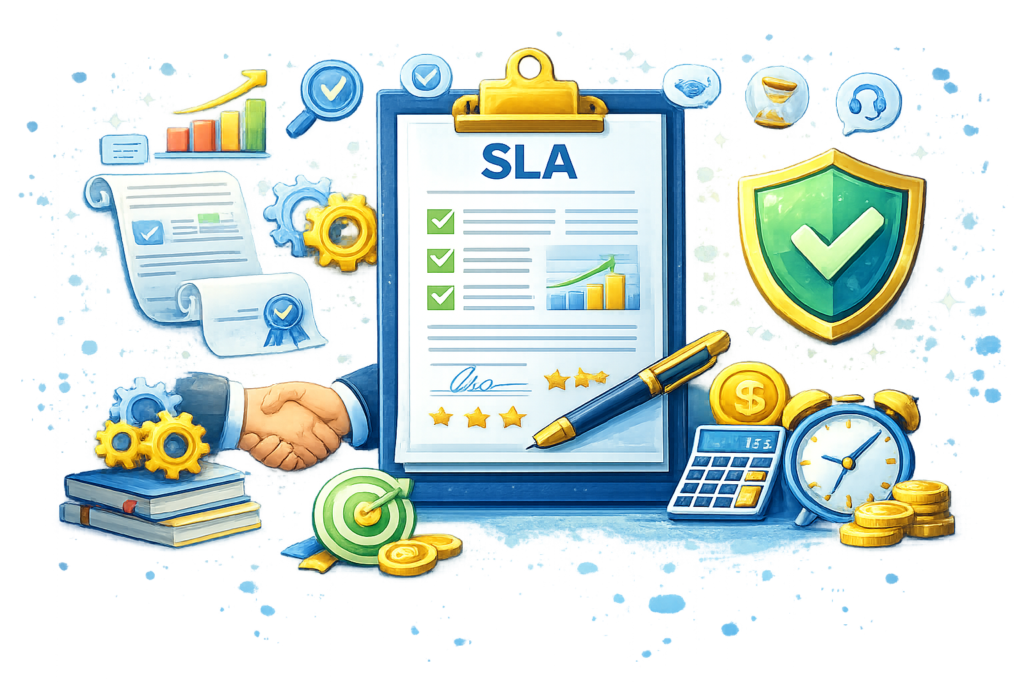
Service Level Agreements (SLAs) define measurable service expectations, response times, uptime commitments, support responsibilities, and remedies for missed targets. Learn how to create enforceable SLAs that improve customer trust, operational performance, and business accountability.
Introduction
For any business that delivers ongoing support, hosting, maintenance, software, marketing, or managed services, Service Level Agreements (SLAs) are one of the most important documents you can put in place. An SLA turns a vague promise such as “we’ll respond quickly” into a measurable commitment with defined response times, uptime targets, escalation procedures, and remedies if standards are not met.
At Monthly Website Design, SLAs are viewed as a practical tool for building transparency and long-term client relationships. A well-written SLA helps both parties understand what is included, what is excluded, how performance is measured, and what happens when issues arise. That clarity reduces disputes, speeds up decision-making, and creates a stronger foundation for ongoing service delivery.
This guide explains SLAs in depth: what they are, why they matter, the metrics that should be included, how to write them, common mistakes to avoid, and the best practices used by high-performing service organisations.
What Is a Service Level Agreement?
A Service Level Agreement is a formal contract between a service provider and a customer that defines the expected level of service. It typically includes availability targets, response times, resolution times, support hours, responsibilities of both parties, reporting methods, escalation paths, and remedies for non-compliance.
The key distinction is that an SLA is measurable. Instead of saying “support is available,” an SLA might specify “critical incidents receive an initial response within 15 minutes, 24/7.” Instead of saying “the website will stay online,” it may commit to “99.9% monthly uptime.” These measurable targets create accountability and make performance objectively verifiable.
SLAs are used across many industries, including IT support, cloud hosting, cybersecurity, SaaS platforms, telecommunications, digital marketing, and website maintenance. Major cloud providers such as Google Cloud publish detailed SLA documents that define uptime guarantees and service credits, which is considered a best-practice approach for transparent service commitments. Google Cloud Service Level Agreements
Why SLAs Matter for Business Growth
Many businesses think of SLAs as legal paperwork, but their real value is operational. A clear SLA reduces ambiguity. Customers know what to expect, and service teams know what they are expected to deliver. That alignment improves efficiency and customer satisfaction simultaneously.
From a commercial perspective, SLAs can become a competitive advantage. When prospects compare providers, they often look for concrete commitments: uptime guarantees, support availability, security monitoring, backup frequency, and escalation procedures. Providers that can demonstrate measurable service standards are generally perceived as more reliable and professional.
SLAs also improve internal performance management. By tracking metrics such as first-response time, resolution time, ticket backlog, and availability, businesses gain visibility into operational bottlenecks. These metrics can then be used for staffing decisions, process improvements, automation initiatives, and customer experience optimisation.
The Different Types of SLAs
Not all SLAs are structured the same way. Choosing the right format depends on the complexity of the service and the number of customers being supported.
Customer-based SLA
This type is tailored to a specific customer. A large enterprise client may receive customised uptime targets, dedicated account management, priority support, and bespoke reporting. Customer-based SLAs are common in managed IT services and enterprise software agreements.
Service-based SLA
A single SLA applies to all customers using the same service. For example, a hosting company may offer the same 99.9% uptime commitment and support response targets to every customer on a particular plan. This approach is easier to manage and standardise.
Multi-level SLA
A multi-level SLA combines both approaches. It may include:
- Corporate-level commitments (security, compliance, business continuity)
- Customer-level commitments (account-specific requirements)
- Service-level commitments (performance targets for a particular product)
This layered structure is especially useful for organisations that provide multiple services to multiple customer segments.
Core Components Every SLA Should Include
A strong SLA is comprehensive without being unnecessarily complex. The following elements are considered essential.
Service description
Define exactly what is being provided. This includes the systems covered, support channels, maintenance activities, monitoring scope, backup responsibilities, and any exclusions.
Performance metrics
Specify measurable targets such as uptime percentage, response time, resolution time, backup recovery objectives, and maintenance windows.
Roles and responsibilities
Clarify what the provider must do and what the customer must do. For example, the customer may be responsible for supplying accurate contact information, approving changes, or reporting incidents through designated channels.
Reporting and review
Explain how performance will be measured and communicated. Regular reporting—monthly or quarterly—helps maintain transparency and supports continuous improvement.
For security-related services, aligning operational commitments with recognised standards such as the NIST Cybersecurity Framework can strengthen the credibility of the SLA.
Understanding Uptime and Availability Metrics
Uptime is one of the most frequently referenced SLA metrics, yet it is also one of the most misunderstood. A percentage alone means very little unless you understand the allowable downtime behind it.
Monthly availability targets
| Availability | Downtime / month |
|---|---|
| 99.0% | ~7h 18m |
| 99.5% | ~3h 39m |
| 99.9% | ~43m |
| 99.95% | ~22m |
| 99.99% | ~4m 23s |
The difference between 99.9% and 99.99% availability is not a rounding error. It is the difference between roughly 43 minutes of downtime per month and just over 4 minutes. For e-commerce stores, payment systems, booking platforms, and other revenue-generating services, that gap can be commercially significant.
A robust SLA should also define how availability is measured. Important questions include:
- What monitoring system is used?
- From which geographic locations is uptime checked?
- How frequently are checks performed?
- Are scheduled maintenance windows excluded from the calculation?
- What constitutes an outage?
Google’s reliability guidance emphasises the importance of clearly defined service objectives and measurement methods. Google Cloud Reliability Framework
Response Time vs Resolution Time
These two metrics are often confused, but they measure very different aspects of support quality.
Response time
Response time measures how quickly the provider acknowledges an issue. For example:
- Critical: 15 minutes
- High: 1 hour
- Medium: 4 hours
- Low: 1 business day
Customers generally care deeply about acknowledgement because it confirms that the issue has been received and is being worked on.
Resolution time
Resolution time measures how long it takes to restore service or fully resolve the issue. This metric is usually more complex because different incidents require different levels of investigation, vendor coordination, testing, and deployment.
A mature SLA includes both metrics. Fast acknowledgement without timely resolution creates frustration, while excellent technical fixes delivered after long periods of silence also damage customer confidence.
How to Define Incident Severity Levels
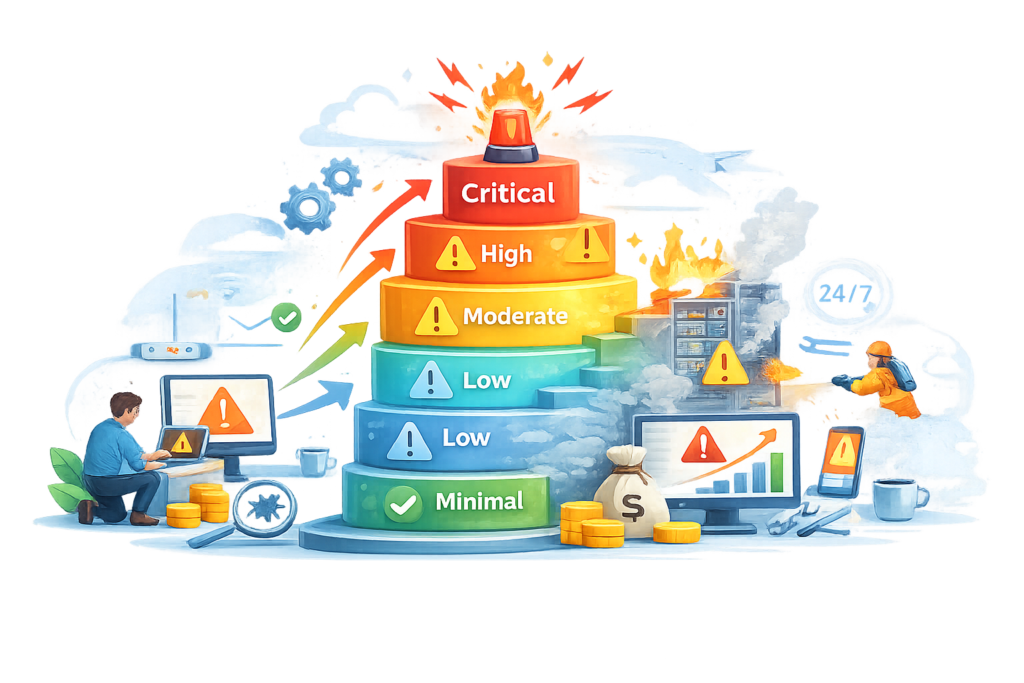
Severity classification is the foundation of an effective support SLA. Without clear severity definitions, every customer issue risks being treated as an emergency.
Recommended incident matrix
| Severity | Typical impact |
|---|---|
| P1 | Complete outage / security incident |
| P2 | Major functionality impaired |
| P3 | Partial degradation / workaround exists |
| P4 | Minor issue / information request |
P1 (Critical) incidents involve complete outages, security breaches, payment failures, or situations where the business cannot operate. These typically require immediate, around-the-clock attention.
P2 (High) incidents affect major functionality but may have a temporary workaround. P3 (Medium) incidents cause partial degradation, while P4 (Low) incidents are minor issues, cosmetic defects, or information requests.
The SLA should include specific examples for each category. That reduces disputes and helps support teams prioritise work consistently.
Setting Realistic and Enforceable SLA Targets
One of the biggest mistakes organisations make is promising targets they cannot consistently achieve. An SLA should be ambitious enough to create value, but realistic enough to be sustainable.
Start with historical performance data. Review actual response times, resolution times, uptime records, staffing levels, and escalation patterns. If your team currently resolves high-priority incidents in an average of six hours, committing to a one-hour resolution target is unlikely to be credible.
Enforceability is equally important. Every target should be measurable through logs, monitoring systems, ticketing platforms, or audit records. Vague phrases such as “best effort,” “as soon as possible,” or “promptly” are difficult to enforce and often become sources of disagreement.
Finally, build in operational flexibility. Define maintenance windows, force majeure events, third-party dependencies, and customer-caused delays. These provisions do not weaken the SLA; they make it more accurate and legally defensible.
Monitoring and Reporting: Measuring SLA Performance Effectively
A Service Level Agreement is only as valuable as the ability to measure whether its commitments are being met. Without consistent monitoring and reporting, even the most carefully written SLA becomes difficult to enforce. Businesses should establish reliable methods for collecting performance data, reviewing trends, and communicating results to customers. This transparency strengthens trust while allowing both parties to identify opportunities for continuous improvement.
Performance monitoring should focus on measurable indicators that directly reflect the agreed service commitments. Common metrics include uptime, average response time, average resolution time, first-contact resolution rate, ticket backlog, system availability, maintenance compliance, and customer satisfaction scores. These metrics should be collected automatically wherever possible using monitoring tools, ticketing systems, and reporting dashboards to reduce manual errors and improve accuracy.
Regular reporting also demonstrates accountability. Monthly or quarterly SLA reports should summarise key performance indicators, highlight any incidents that affected service levels, explain corrective actions taken, and identify improvements planned for the next reporting period. Well-structured reports help customers understand not only whether targets were achieved but also how the provider is continuously improving service quality.
Escalation Procedures: Resolving Issues Quickly and Efficiently
Even with excellent planning, service disruptions and unexpected incidents can occur. A clearly defined escalation process ensures that issues receive the appropriate level of attention based on their severity and business impact. Without an escalation framework, support teams may struggle to prioritise work, leading to inconsistent service delivery and customer frustration.
An effective escalation procedure begins with clearly identifying when an issue should move beyond first-line support. Critical outages, security incidents, and widespread service interruptions often require immediate involvement from senior technical specialists or management. Each escalation stage should specify who is responsible, expected response times, communication requirements, and decision-making authority.
Communication plays a critical role during escalations. Customers should receive regular status updates throughout the incident lifecycle, even if the issue has not yet been resolved. Consistent communication reassures customers that progress is being made while reducing uncertainty during high-impact situations.
Service Credits and Remedies for SLA Breaches
An SLA should explain what happens if agreed service levels are not achieved. This section protects both the service provider and the customer by defining fair remedies for measurable failures. Rather than focusing on punishment, service credits encourage continuous improvement and reinforce accountability.
Service credits are commonly applied when availability or response commitments fall below agreed thresholds. For example, if a hosting service guarantees 99.9% uptime but achieves only 99.5% during a billing period, the customer may receive a percentage credit toward future services. The exact calculation should be clearly documented within the SLA to avoid misunderstandings.
It is equally important to define exclusions. Events outside the provider’s reasonable control—such as natural disasters, internet backbone failures, customer-caused configuration issues, or scheduled maintenance windows—may not qualify for service credits. Clearly documenting these exceptions ensures fairness while maintaining realistic expectations for both parties.
Security, Compliance, and Data Protection Commitments
Security is a critical component of modern Service Level Agreements. Customers increasingly expect providers to demonstrate how they protect confidential information, manage access controls, perform regular updates, and respond to cybersecurity incidents. Including security commitments within an SLA helps establish confidence while supporting regulatory compliance.
Security responsibilities should clearly define patch management schedules, vulnerability monitoring, access management procedures, encryption standards, backup policies, and incident response processes. Organisations should also identify customer responsibilities, such as maintaining secure passwords, approving authorised users, and promptly reporting suspected security concerns.
Businesses operating within regulated industries should ensure their SLAs align with recognised standards where applicable. Guidance from the National Institute of Standards and Technology (NIST) and the UK National Cyber Security Centre (NCSC) provides valuable recommendations for establishing secure operational practices and managing cybersecurity risks.
Backup, Disaster Recovery, and Business Continuity
Business continuity planning is essential for maintaining reliable services. An SLA should clearly explain how customer data is protected, how frequently backups are performed, where backup data is stored, and how quickly services can be restored following an incident.
Recovery objectives are particularly important. The Recovery Time Objective (RTO) specifies how quickly services should be restored after an outage, while the Recovery Point Objective (RPO) defines the maximum acceptable amount of data loss measured in time. These objectives should reflect the criticality of the service being provided.
Testing is equally important. Disaster recovery plans should be reviewed and tested regularly to verify that restoration procedures function as expected. Periodic testing identifies weaknesses before real incidents occur, allowing organisations to improve resilience and minimise disruption.
Reviewing and Updating an SLA
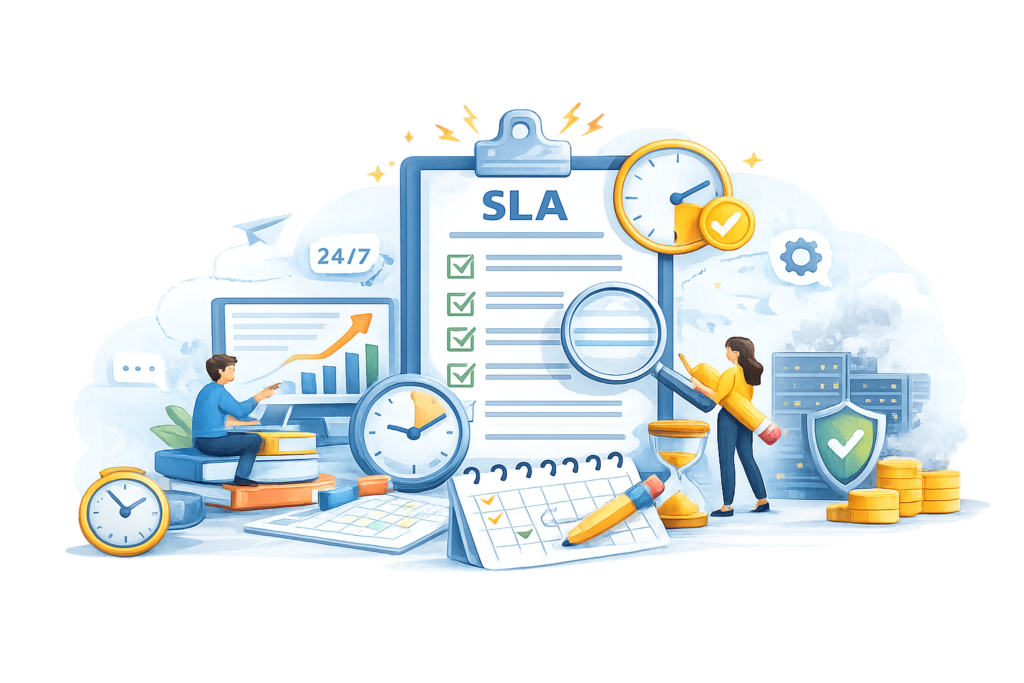
Business requirements evolve over time, making regular SLA reviews essential. New technologies, changing customer expectations, increased workloads, and regulatory updates may all require modifications to existing service commitments. An outdated SLA can create confusion, increase operational risk, and reduce customer confidence.
Scheduled reviews—typically every six or twelve months—allow both parties to evaluate current performance, discuss changing business needs, and agree on necessary updates. Performance reports, customer feedback, incident trends, and operational improvements should all inform the review process.
Version control is also important. Every SLA revision should include a revision history documenting the changes made, implementation dates, and approval by authorised representatives. Maintaining accurate records supports transparency while simplifying future reviews.
Common Mistakes Businesses Make with Service Level Agreements
Many organisations unintentionally weaken their SLAs by making avoidable mistakes. Recognising these common issues helps create stronger, more effective agreements.
Common mistakes include:
- Making unrealistic performance promises without sufficient operational capacity.
- Using vague language instead of measurable commitments.
- Failing to define customer responsibilities.
- Omitting escalation procedures.
- Not specifying maintenance windows.
- Ignoring reporting and performance reviews.
- Overlooking security obligations.
- Failing to update SLAs as services evolve.
Avoiding these mistakes significantly improves both service quality and customer satisfaction.
Best Practices Summary
Successful Service Level Agreements share several common characteristics. They are written in clear language, contain measurable commitments, define responsibilities for both parties, include realistic performance targets, establish transparent reporting methods, and provide fair remedies when agreed standards are not achieved.
Best-in-class organisations also review SLAs regularly, monitor performance continuously, automate reporting wherever possible, and maintain open communication with customers throughout the service lifecycle. These practices transform SLAs from contractual documents into valuable operational management tools.
Organisations should treat their SLA as a living document that evolves alongside business growth, technological advancements, and customer expectations. Continuous improvement ensures the agreement remains relevant, practical, and beneficial for everyone involved.
Frequently Asked Questions
1. What is the primary purpose of a Service Level Agreement?
An SLA defines measurable service expectations, responsibilities, and performance standards between a service provider and a customer.
2. Who should create an SLA?
Typically, both the service provider and the customer collaborate to ensure the agreement accurately reflects business requirements and operational capabilities.
3. What metrics should every SLA include?
Common metrics include uptime, response time, resolution time, availability, maintenance schedules, customer responsibilities, and reporting frequency.
4. Are SLAs legally enforceable?
Many SLAs form part of a contractual agreement. Their enforceability depends on how they are drafted and the governing legal jurisdiction.
5. How often should an SLA be reviewed?
Most organisations review SLAs every six to twelve months or whenever significant service changes occur.
6. What happens if service levels are not achieved?
The SLA should define remedies such as service credits, corrective actions, escalation procedures, or contractual remedies where appropriate.
7. Can one business have multiple SLAs?
Yes. Different services, customers, or departments may require separate SLAs tailored to their specific operational requirements.
8. Why are measurable metrics so important?
Measurable metrics eliminate ambiguity, enable objective performance evaluation, improve accountability, and strengthen customer trust.
Conclusion
A well-designed Service Level Agreement is far more than a contractual document—it is a strategic framework that establishes accountability, transparency, and measurable service excellence. By clearly defining responsibilities, performance expectations, reporting methods, security commitments, escalation procedures, and continuous improvement processes, organisations can build stronger customer relationships while reducing operational risk.
At Monthly Website Design, we believe that clear communication and measurable commitments form the foundation of long-term business success. Well-crafted SLAs not only protect both service providers and customers but also encourage consistent performance, increased trust, and sustainable growth in an increasingly competitive digital marketplace.
Want to Implement This Easily?
Prompt Text
You are an expert consultant. Based on the blog post titled “Service Level Agreements”, provide a step-by-step, practical implementation guide. Include tools, best practices, common mistakes to avoid, and advanced tips. Assume the reader wants to implement everything discussed in this article effectively.
Call to Action
Want our help implementing this? Just reach out to us via our website contact form: https://monthlywebsitedesign.co.uk/contact-us/