

Service Level Agreements (SLAs) define measurable service expectations, performance metrics, responsibilities, and accountability between service providers and clients. Learn SLA types, key components, best practices, KPIs, monitoring methods, and implementation strategies to improve business performance and customer satisfaction.
Introduction
Every successful business relationship depends on clear expectations, measurable performance, and mutual accountability. Whether an organization provides website management, cloud hosting, IT support, cybersecurity, digital marketing, or managed services, customers want confidence that promised services will consistently meet agreed standards. This is where Service Level Agreements (SLAs) become essential.
At Monthly Website Design, we understand that long-term client relationships are built on transparency, reliability, and measurable service quality. A well-designed SLA eliminates uncertainty by defining exactly what services will be delivered, how performance will be measured, response times, responsibilities, escalation procedures, and the remedies available if agreed service levels are not achieved. Instead of relying on assumptions, both parties operate with documented expectations that reduce misunderstandings and encourage continuous improvement.
This comprehensive guide explores every aspect of Service Level Agreements, from their purpose and benefits to key components, performance metrics, monitoring methods, legal considerations, industry best practices, and implementation strategies. Whether you are a business owner selecting a service provider or an organization designing professional service agreements, this guide provides practical insights that align with modern business standards and industry best practices.
What Is a Service Level Agreement (SLA)?
A Service Level Agreement (SLA) is a formal contract that defines the level of service a provider commits to delivering. Rather than describing services in general terms, an SLA establishes measurable objectives, responsibilities, performance targets, communication procedures, reporting standards, and accountability mechanisms. It transforms expectations into documented commitments that both parties can monitor throughout the relationship.
An effective SLA typically specifies important service characteristics such as system availability, response times, issue resolution targets, maintenance schedules, security responsibilities, reporting frequency, escalation procedures, and acceptable performance thresholds. These measurable commitments allow organizations to objectively determine whether services are meeting agreed standards instead of relying on subjective opinions or assumptions.
Modern organizations increasingly depend on digital infrastructure, cloud services, managed IT support, cybersecurity, website maintenance, software platforms, and digital marketing providers. Because many critical business functions are outsourced, SLAs have become indispensable tools for managing operational risk and maintaining service consistency. By clearly defining service expectations before work begins, businesses reduce disputes, strengthen collaboration, improve transparency, and establish a framework for continuous performance improvement.
Why Service Level Agreements Matter for Modern Businesses
Businesses today operate in environments where even minor service interruptions can lead to financial losses, reputational damage, reduced productivity, and dissatisfied customers. A properly developed SLA minimizes these risks by establishing measurable expectations before services begin. Instead of debating what constitutes acceptable performance after an issue occurs, both parties rely on predefined standards that simplify communication and accelerate resolution.
Service Level Agreements also strengthen trust between providers and clients. Customers gain confidence because they know exactly what service quality they should expect, while providers benefit from clearly defined responsibilities that prevent unrealistic demands. This transparency improves working relationships, encourages accountability, and reduces conflicts that often arise from ambiguous contracts.
Beyond operational clarity, SLAs support strategic business planning. Organizations can measure vendor performance using predefined Key Performance Indicators (KPIs), compare service providers objectively, identify recurring issues, and improve budgeting decisions. Performance reporting also helps executives evaluate whether outsourcing arrangements continue delivering value over time. Businesses that consistently monitor SLA compliance are generally better positioned to improve operational efficiency, customer satisfaction, and long-term service quality.
Core Objectives of a Successful Service Level Agreement
The primary objective of any SLA is to establish a mutual understanding of expected service performance. Rather than simply documenting services offered, an SLA creates measurable commitments that both provider and client agree to uphold. This shared understanding reduces ambiguity and helps prevent disagreements throughout the business relationship.
Another important objective is performance measurement. Organizations cannot improve services without reliable data. SLAs define measurable indicators that enable both parties to monitor availability, responsiveness, resolution efficiency, customer satisfaction, security performance, maintenance activities, and compliance with agreed standards. Regular performance reviews transform service management from reactive problem-solving into proactive continuous improvement.
A well-designed SLA also promotes accountability and transparency. Service providers understand the standards they must maintain, while customers know their own responsibilities, including providing necessary access, timely approvals, accurate information, and designated points of contact. Clearly assigning responsibilities prevents delays caused by unclear ownership and supports faster issue resolution. This balanced approach encourages collaboration rather than conflict, creating long-term partnerships instead of transactional vendor relationships.
Essential Components Every SLA Should Include
An effective Service Level Agreement contains several interconnected components that collectively define how services will be delivered and evaluated. The agreement should begin with a clear description of the services covered, ensuring there is no ambiguity regarding the provider’s responsibilities. Precise service definitions reduce misunderstandings and create a reliable reference point throughout the contract period.
Performance metrics represent another critical element. These metrics may include system uptime percentages, response times, resolution targets, maintenance windows, availability commitments, backup schedules, recovery objectives, security monitoring, reporting frequency, and customer support standards. Each metric should be measurable, realistic, and aligned with business objectives. Avoid vague language such as “fast response” or “reasonable availability.” Instead, specify measurable targets that both parties can verify objectively.
An SLA should also define roles, responsibilities, exclusions, escalation procedures, communication channels, reporting schedules, review processes, and service credits where appropriate. Where cybersecurity responsibilities are included, businesses should align their processes with the OWASP Foundation and the NIST Cybersecurity Framework to strengthen vulnerability management, incident response, and security governance. Clearly identifying exceptions is equally important because not every service interruption falls under provider responsibility. Scheduled maintenance, customer-caused issues, third-party failures, force majeure events, and unauthorized system modifications should be documented to establish fair accountability and prevent future disputes.
Different Types of Service Level Agreements
Organizations use several types of Service Level Agreements depending on the complexity of services and the relationships involved. Understanding these variations helps businesses select an agreement structure that matches their operational requirements and service delivery model.
A Customer-Based SLA is designed for an individual client and covers all services delivered under a specific agreement. This approach is ideal when services are highly customized, allowing organizations to tailor performance targets, reporting requirements, and responsibilities according to unique business needs. Customized SLAs often support enterprise clients with specialized operational requirements and dedicated service teams.
A Service-Based SLA applies standardized performance commitments across all customers receiving the same service. Internet hosting providers, managed website maintenance companies, cloud platforms, and software providers commonly use this model because it simplifies service management while maintaining consistency. Larger organizations may also implement Multi-Level SLAs, separating corporate-wide commitments, department-specific expectations, and service-level metrics. This layered structure accommodates complex organizations that require different performance standards across multiple business units while maintaining overall governance and consistency.
Key SLA Metrics and KPIs That Measure Service Performance
Organizations cannot improve what they do not measure. That is why Key Performance Indicators (KPIs) and measurable Service Level Agreement metrics are the foundation of every successful SLA. These indicators provide objective evidence of whether a service provider is meeting contractual commitments while giving customers confidence that services are being delivered consistently. Instead of relying on opinions, both parties evaluate performance using transparent, data-driven measurements.
One of the most common SLA metrics is service availability (uptime). For digital services such as website hosting, managed IT support, cloud platforms, or business applications, uptime is typically expressed as a percentage over a defined period. For example, a commitment of 99.9% uptime allows only a limited amount of downtime each month. Other essential KPIs include first response time, average resolution time, incident resolution rate, mean time to respond (MTTR), mean time to repair, ticket backlog, escalation frequency, and customer satisfaction scores. Together, these metrics provide a balanced view of operational performance rather than focusing on a single measurement.
Businesses should also measure service quality using customer-focused indicators. Organizations managing websites and digital services can also measure business performance by following guidance from Google Analytics Help Center, which explains how to monitor user engagement, conversions, and overall website performance. These may include customer satisfaction surveys, Net Promoter Score (NPS), service review meetings, issue recurrence rates, and compliance reports. Security-related SLAs often track vulnerability response times, patch management schedules, backup success rates, disaster recovery testing, and compliance with industry regulations. Selecting meaningful KPIs ensures that the SLA measures outcomes that directly support business objectives rather than simply tracking operational activity.
Response Time vs Resolution Time: Understanding the Difference
Although response time and resolution time are often mentioned together, they represent two distinct service commitments within an SLA. Confusing these metrics can lead to unrealistic customer expectations and unnecessary disputes. A well-written SLA clearly defines both measurements and explains how they are calculated.
Response time refers to how quickly the service provider acknowledges a reported issue after receiving a support request. For example, a critical incident may require acknowledgement within fifteen minutes, while lower-priority requests might have a response target of four business hours. A fast response reassures customers that their issue has been recognized and appropriate action has begun. However, acknowledging a problem does not necessarily mean it has been solved.
Resolution time, on the other hand, measures the total time required to fully resolve the reported issue or restore agreed service levels. Resolution targets usually vary according to incident severity. Critical outages affecting business operations often receive the highest priority and shortest resolution targets, whereas cosmetic issues or enhancement requests may have longer timelines. Separating these two metrics provides realistic expectations for customers while allowing service providers to prioritize resources according to business impact. Clearly defining incident priority levels further strengthens the effectiveness of these measurements.
How SLA Monitoring and Reporting Drive Continuous Improvement
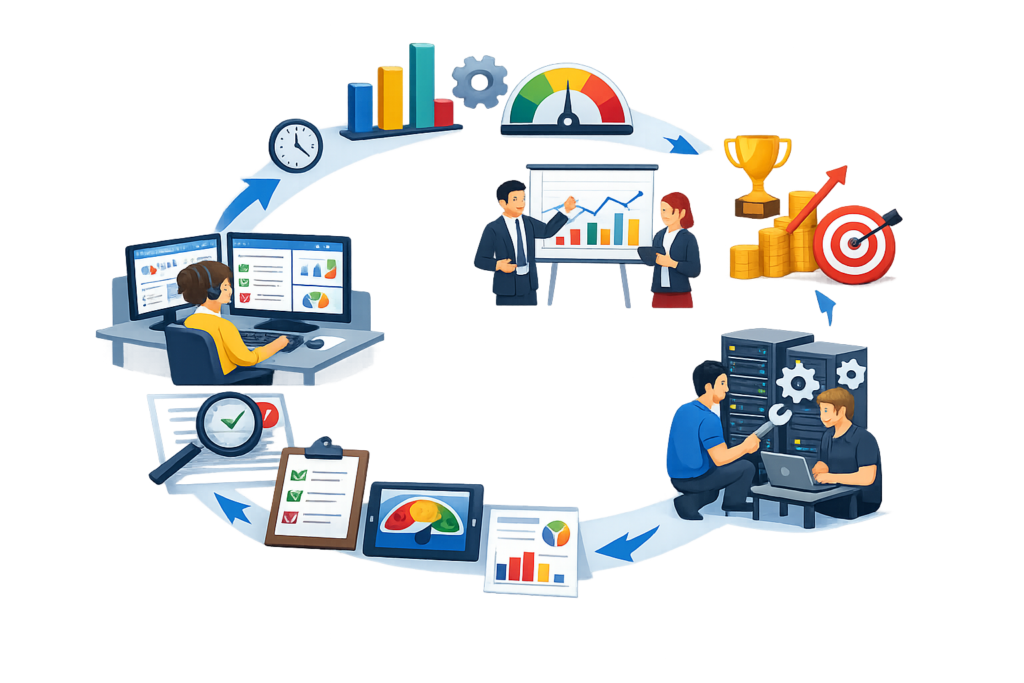
Creating an SLA is only the beginning. Without ongoing monitoring, reporting, and review, even the most detailed agreement loses value over time. Continuous performance monitoring enables organizations to identify trends, measure compliance, detect recurring issues, and improve service delivery before small problems become significant operational risks.
Modern organizations rely on automated monitoring platforms that collect real-time data on availability, system health, network performance, application responsiveness, security events, and customer support activities. For websites and online services, businesses should also use Google Search Console to monitor indexing, crawl issues, and search performance, while the Google Analytics Help Center provides guidance for measuring visitor behaviour and business outcomes. These tools generate dashboards and reports that compare actual performance against agreed SLA targets. Automated monitoring minimizes human error while providing accurate historical records for future analysis. Regular reporting also strengthens transparency because both provider and customer review the same performance data.
Performance review meetings should occur at predetermined intervals, such as monthly or quarterly, depending on service complexity. These meetings allow both parties to discuss KPI performance, identify improvement opportunities, evaluate recurring incidents, review upcoming business changes, and adjust SLA targets when necessary. Continuous improvement is most effective when supported by documented action plans, measurable objectives, and ongoing collaboration. Rather than treating SLAs as static contracts, successful organizations use them as living documents that evolve alongside changing business requirements.
Common Challenges When Managing Service Level Agreements
Even well-designed SLAs can encounter challenges if expectations, communication, or business priorities change over time. One of the most common problems is creating agreements that contain vague or subjective language. Statements such as “quick response,” “high-quality support,” or “reasonable availability” leave room for interpretation and frequently become sources of disagreement. Effective SLAs replace ambiguous wording with measurable performance standards that both parties can verify objectively.
Another challenge involves setting unrealistic performance targets. Customers naturally seek the highest possible service levels, while providers must balance operational capabilities, staffing, infrastructure, and costs. Overly aggressive commitments may appear attractive during contract negotiations but become difficult to maintain consistently. Missing SLA targets repeatedly damages customer confidence, reduces credibility, and increases contractual risk. Realistic commitments supported by operational data provide a stronger foundation for long-term partnerships.
Business growth also introduces new complexities. As organizations expand, service requirements, technology platforms, customer expectations, and regulatory obligations often evolve. SLAs that remain unchanged for several years may no longer reflect operational realities. Regular reviews ensure that service commitments continue supporting business objectives while accommodating technological advancements, increased workloads, and changing customer needs. Maintaining flexibility without compromising accountability is one of the defining characteristics of mature SLA management.
Common Service Level Agreement Mistakes Businesses Should Avoid
Many organizations invest significant effort into negotiating contracts but overlook critical details when developing their Service Level Agreements. One frequent mistake is focusing exclusively on technical metrics while ignoring customer experience. Excellent uptime means little if support requests are handled poorly or communication is inconsistent. Effective SLAs balance technical performance with service quality, responsiveness, and customer satisfaction.
Another common mistake is failing to define responsibilities for both parties. Customers sometimes assume providers are responsible for every service interruption, while providers expect customers to supply timely information, system access, approvals, or internal resources. Clearly documenting shared responsibilities prevents unnecessary delays and ensures accountability remains balanced throughout the service relationship.
Businesses should also avoid treating SLAs as documents that are signed once and forgotten. Technology, cybersecurity risks, compliance requirements, and customer expectations change continuously. Agreements that remain static quickly become outdated and less effective. Organizations should establish formal review schedules, evaluate performance metrics regularly, incorporate lessons learned from previous incidents, and update SLA terms whenever significant operational or technological changes occur. Continuous review transforms SLAs into strategic management tools rather than simple contractual documents.
Best Practices for Creating Effective Service Level Agreements
Developing an effective SLA requires careful planning, collaboration, and continuous improvement. The agreement should begin with clearly defined business objectives before technical performance metrics are selected. Understanding what customers truly value allows organizations to design service commitments that support measurable business outcomes instead of merely documenting operational activities.
Performance targets should always be measurable, achievable, relevant, and time-bound. When the SLA covers website management or digital services, organizations should regularly evaluate performance using Google PageSpeed Insights and audit technical quality with Google Lighthouse. They should also follow recommendations published on Google Search Central to ensure websites meet Google’s technical best practices. Every KPI should have a clearly defined measurement method, reporting schedule, and responsible owner. Service definitions, exclusions, maintenance windows, escalation procedures, communication channels, and review processes should all be documented in language that is easy for both technical and non-technical stakeholders to understand. Simplicity improves compliance because expectations remain clear throughout the contract lifecycle.
Finally, organizations should embrace continuous improvement as a core SLA principle. Regular performance reviews, customer feedback, incident analysis, technology assessments, and business planning sessions help refine service commitments over time. Successful SLAs evolve alongside organizational growth, emerging technologies, cybersecurity requirements, and changing customer expectations. Businesses that continuously review and improve their agreements are better positioned to deliver reliable, consistent, and customer-focused services.
Future Trends Shaping Service Level Agreements

Digital transformation continues to reshape how businesses deliver and consume services, and Service Level Agreements are evolving alongside these changes. Traditional SLAs focused primarily on uptime and response times, but modern organizations now expect agreements to measure customer experience, cybersecurity resilience, regulatory compliance, automation, and business outcomes. As organizations adopt cloud computing, artificial intelligence (AI), edge computing, and hybrid work environments, SLAs must become more dynamic and data-driven.
Artificial intelligence is increasingly being used to predict service disruptions before they occur. Predictive monitoring, automated incident detection, intelligent ticket routing, and self-healing infrastructure enable providers to resolve many issues before customers even notice them. Future SLAs are likely to include proactive service commitments, such as predictive maintenance, automated security monitoring, and AI-assisted performance optimization. These capabilities improve reliability while reducing downtime and operational costs.
Another important trend is the growing emphasis on cybersecurity and compliance. Many organizations are adopting internationally recognized guidance such as ISO Standards, alongside recommendations from the OWASP Foundation and the NIST Cybersecurity Framework to improve governance, compliance, and operational resilience. Businesses increasingly expect providers to include measurable security commitments covering vulnerability management, patch deployment, backup verification, disaster recovery, and incident response. Environmental sustainability is also becoming a consideration, with some organizations requesting reporting on energy efficiency and environmentally responsible data center operations. Future-ready SLAs will focus not only on technical performance but also on resilience, transparency, security, and long-term business value.
Frequently Asked Questions
1. What is the primary purpose of a Service Level Agreement?
The primary purpose of an SLA is to define measurable service expectations between a service provider and a customer. It clearly outlines responsibilities, performance standards, communication procedures, and accountability, ensuring both parties understand what is expected throughout the business relationship.
2. What services typically require an SLA?
SLAs are commonly used for website maintenance, managed hosting, cloud services, IT support, cybersecurity, software development, digital marketing, telecommunications, managed print services, and many other outsourced business services where measurable performance is essential.
3. What are the most important SLA metrics?
Some of the most common metrics include:
- System uptime
- Response time
- Resolution time
- Incident resolution rate
- Customer satisfaction
- First-contact resolution
- Security compliance
- Backup success rate
- Performance reporting accuracy
The exact metrics depend on the services being provided.
4. How often should an SLA be reviewed?
Most organizations review SLAs every quarter or every six months. However, significant business changes, technology upgrades, regulatory updates, or new customer requirements may require more frequent revisions to ensure the agreement remains relevant and effective.
5. What happens if an SLA is not achieved?
The agreement should specify the actions that will occur if service levels are missed. These may include service credits, escalation procedures, corrective action plans, additional reporting requirements, or contract reviews. Clearly defining these outcomes encourages accountability while supporting continuous service improvement.
6. Are SLAs legally binding?
In many cases, yes. When included as part of a signed commercial contract, an SLA can become legally enforceable depending on the applicable laws and contract terms. Organizations should seek professional legal advice when drafting agreements involving significant financial or operational risk.
7. Can an SLA be customized?
Absolutely. While many providers offer standard SLAs, enterprise customers often require customized agreements that reflect unique business priorities, operational requirements, compliance obligations, and industry-specific performance standards.
8. Why are measurable KPIs important in an SLA?
KPIs provide objective evidence of service performance. Without measurable indicators, it becomes difficult to determine whether agreed service levels are being achieved. Well-defined KPIs improve transparency, strengthen accountability, and support data-driven decision-making.
Best Practices Summary
Creating an effective Service Level Agreement requires more than listing response times or availability targets. Organizations should align every SLA with measurable business objectives, customer expectations, and operational capabilities. Performance metrics should be realistic, clearly defined, and easy to monitor. Both parties should understand their responsibilities, communication processes, escalation paths, maintenance schedules, exclusions, and reporting requirements before services begin.
Continuous monitoring is equally important. Organizations should also follow the W3C Web Accessibility Initiative (WAI) to help ensure their digital services remain accessible, inclusive, and aligned with internationally recognized web accessibility standards. Businesses should regularly review performance reports, analyze recurring incidents, gather customer feedback, and update SLA commitments as technology, security requirements, and organizational priorities evolve. Maintaining open communication and scheduling periodic service review meetings helps strengthen long-term partnerships while ensuring continuous improvement.
Finally, businesses should view SLAs as strategic management tools rather than simple contractual documents. A well-maintained SLA reduces operational risk, improves service quality, enhances customer satisfaction, increases transparency, and supports sustainable business growth. Organizations that invest in clear, measurable, and regularly reviewed agreements are better positioned to build trusted partnerships and consistently deliver high-quality services.
Conclusion
A well-structured Service Level Agreement is far more than a contractual requirement—it is a framework for trust, accountability, and continuous service excellence. By defining measurable expectations, performance indicators, communication processes, and responsibilities, businesses can reduce misunderstandings, improve operational efficiency, and build stronger long-term partnerships.
At Monthly Website Design, we believe that transparency and measurable service quality are essential to delivering dependable digital solutions. Whether your organization requires website management, hosting, technical support, or ongoing maintenance, a carefully designed SLA helps ensure every service is delivered consistently and aligned with your business objectives. Investing time in creating and maintaining a robust SLA today will help establish stronger relationships, improve customer confidence, and support sustainable business success in the years ahead.
Want to Implement This Easily?
Prompt
You are an expert consultant. Based on the blog post titled “Service Level Agreements”, provide a step-by-step, practical implementation guide. Include tools, best practices, common mistakes to avoid, and advanced tips. Assume the reader wants to implement everything discussed in this article effectively.
Call to Action
Want our help implementing this? Just reach out to us via our website contact form: