
Learn everything about SLA’s (Service Level Agreements), including types, benefits, performance metrics, uptime guarantees, legal considerations, cybersecurity standards, and best practices for improving business reliability and operational performance.
Introduction
In today’s highly competitive digital economy, businesses depend heavily on reliable technology providers, cloud platforms, managed IT services, hosting companies, software vendors, and cybersecurity teams. One of the most important documents governing these professional relationships is the Service Level Agreement, commonly known as an SLA. A well-structured SLA establishes expectations, defines accountability, minimizes disputes, and ensures consistent service delivery between providers and clients.
Modern organizations rely on digital systems for communication, sales, operations, customer management, and data storage. When services fail or performance standards are unclear, businesses can experience downtime, revenue loss, reputational damage, and operational disruption. SLA’s help prevent these issues by clearly outlining measurable service commitments, response times, support standards, escalation procedures, uptime guarantees, and compensation policies.
At Monthly Website Design, businesses increasingly seek dependable digital services supported by transparent SLA frameworks that align with modern security standards, technical reliability, and performance expectations. Understanding how SLA’s work is essential for companies that want stronger operational stability, better customer experiences, and long-term business growth.
What Are SLA’s and Why Do They Matter?
A Service Level Agreement is a formal contract between a service provider and a customer that defines the expected level of service. SLA’s include measurable commitments such as uptime percentages, technical support response times, issue resolution targets, maintenance schedules, and service availability standards.
Businesses rely on SLA’s because they create transparency and accountability. Instead of depending on verbal promises or vague expectations, organizations can evaluate services using clearly documented performance metrics. For example, a hosting company may guarantee 99.9% uptime, while a managed IT provider may commit to resolving critical technical issues within four hours.
SLA’s are especially important in industries where operational continuity is critical. Cloud computing providers, software companies, cybersecurity firms, telecommunications providers, and website hosting services commonly use SLA’s to define service expectations and build customer trust.
The Core Purpose of a Service Level Agreement
The primary purpose of an SLA is to establish clear expectations between a service provider and a client. Outsourcing services can improve efficiency, reduce costs, and provide access to specialized expertise, but unclear expectations often lead to misunderstandings and operational problems.
A properly written SLA eliminates ambiguity by documenting exactly how services will be delivered, monitored, and maintained. This includes performance metrics, support availability, communication procedures, reporting schedules, and escalation paths. Businesses can use these agreements to measure provider performance objectively rather than relying on assumptions.
Strong SLA frameworks also improve professional relationships. When responsibilities and expectations are clearly documented, providers and customers can collaborate more effectively. Instead of focusing on blame during service issues, both parties can rely on predefined processes and measurable standards to resolve problems efficiently.
Different Types of SLA’s Businesses Should Understand
There are several types of SLA’s designed for different business models and operational requirements. Understanding these structures helps organizations choose agreements that align with their service expectations and risk management goals.
A customer-based SLA is tailored for a single customer and covers all services provided to that client. These agreements often include customized performance targets, security requirements, and support processes designed specifically for that organization’s needs.
A service-based SLA applies to a single service delivered to multiple customers. For example, a hosting provider may offer the same uptime guarantee and support standards to every customer using a specific hosting plan. Multi-level SLA’s combine customer-level, service-level, and organizational-level agreements into layered structures that support complex enterprise environments.
Key Components Included in Professional SLA’s
Professional SLA’s contain several essential components that ensure transparency, accountability, and measurable performance tracking. One of the most important sections is the service scope, which clearly defines what services are included and excluded within the agreement.
Performance metrics are another critical component. These metrics often include uptime percentages, issue response times, resolution deadlines, support availability, server performance, and customer satisfaction benchmarks. Effective metrics must be realistic, measurable, and aligned with operational goals.
Other important SLA components include escalation procedures, reporting standards, maintenance windows, backup policies, disaster recovery processes, security responsibilities, and financial compensation terms. Businesses should review these sections carefully to ensure they align with operational requirements and long-term business objectives.
Understanding Uptime Guarantees and Availability Metrics
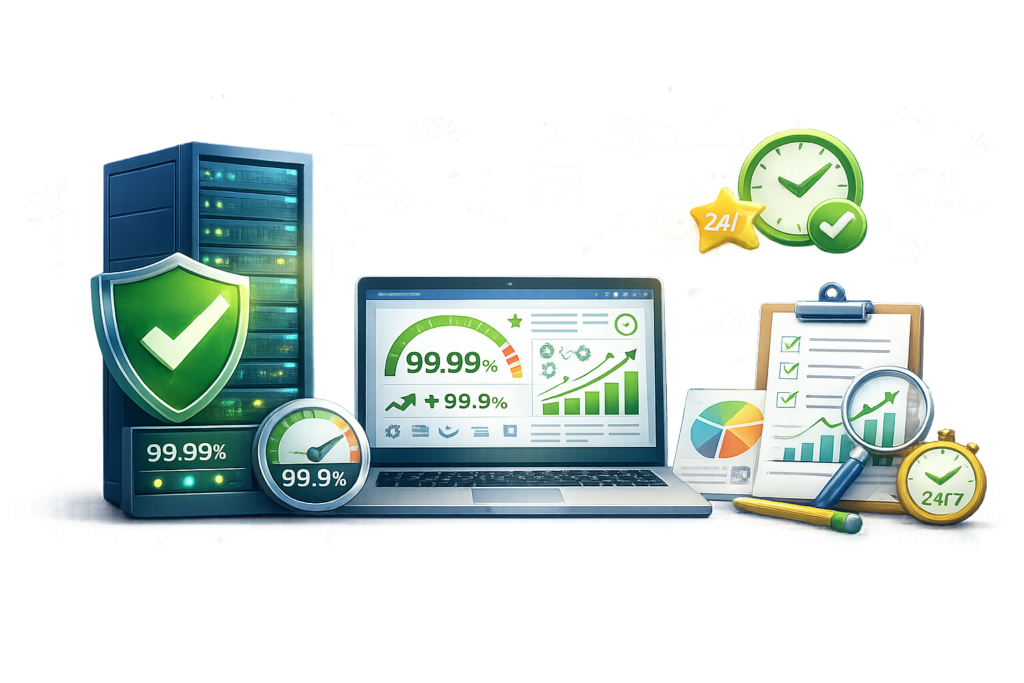
Uptime guarantees are among the most discussed elements of SLA’s, particularly in hosting, cloud computing, and software services. Uptime refers to the percentage of time a system or service remains operational and accessible during a specified period.
For example, a 99.9% uptime guarantee allows for approximately 8.76 hours of downtime annually, while a 99.99% guarantee reduces downtime significantly. Although these percentages appear similar, the operational impact can be substantial for businesses relying on continuous service availability.
Organizations should carefully evaluate how uptime is measured and what exclusions apply. Some providers exclude scheduled maintenance or third-party disruptions from calculations. Businesses should also review infrastructure redundancy, backup systems, and monitoring procedures to ensure reliability standards align with operational needs. Technical performance recommendations from Google SEO Starter Guide also emphasize reliability and user experience as essential digital performance factors.
Response Time vs Resolution Time in SLA’s
Many businesses mistakenly assume response time and resolution time mean the same thing, but they represent different service metrics within SLA management.
Response time measures how quickly a provider acknowledges an issue after it has been reported. For example, a cybersecurity provider may commit to responding to critical incidents within 15 minutes. Fast response times reassure customers that problems are receiving immediate attention.
Resolution time measures how long it takes to fully resolve the issue after acknowledgment. Complex technical problems may require investigation, testing, infrastructure changes, or collaboration between multiple teams. Businesses should evaluate both metrics carefully because a provider may respond quickly while still taking too long to resolve the actual issue.
The Role of SLA’s in Cloud Computing Services
Cloud computing has transformed how businesses manage operations, store data, and deploy software applications. As reliance on cloud infrastructure grows, SLA’s have become increasingly important for defining service reliability, security standards, and operational continuity.
Cloud provider SLA’s commonly define system availability, backup policies, recovery objectives, network performance, data protection standards, and customer support availability. These agreements help organizations understand exactly what level of service they can expect from cloud vendors.
Security is especially important in cloud-based environments. Professional SLA’s should explain encryption standards, incident response procedures, disaster recovery commitments, and compliance requirements. Businesses handling sensitive information should prioritize providers aligned with recommendations from the Cybersecurity and Infrastructure Security Agency and Google Cloud Security.
Why SLA’s Are Essential for Website Hosting
Website hosting companies commonly use SLA’s to guarantee uptime, server reliability, maintenance schedules, and technical support availability. Businesses relying on websites for sales, customer engagement, and lead generation cannot afford unreliable hosting environments.
A strong hosting SLA should define uptime commitments, backup frequency, support channels, maintenance windows, server monitoring practices, and escalation procedures. Businesses should also review refund policies and compensation clauses related to downtime or prolonged service disruptions.
Website performance directly affects search engine visibility and user experience. Google’s Core Web Vitals guidelines emphasize speed, responsiveness, and stability as critical usability factors. Reliable hosting supported by a transparent SLA helps businesses maintain strong website performance and customer trust.
SLA’s and Cybersecurity Risk Management
Cybersecurity threats continue to evolve rapidly, making SLA’s increasingly important for businesses relying on security providers, managed IT teams, and cloud services. Security-focused SLA’s help organizations define responsibilities and reduce operational risk.
Cybersecurity SLA’s often include threat monitoring, vulnerability management, patch deployment timelines, incident response commitments, encryption standards, and disaster recovery expectations. These agreements help businesses improve preparedness and minimize potential security disruptions.
Organizations should also evaluate whether providers comply with internationally recognized standards such as ISO/IEC 27001. Compliance-focused SLA’s demonstrate a provider’s commitment to maintaining strong information security practices and protecting sensitive business data.
Common SLA Metrics Businesses Should Monitor
Tracking SLA metrics is essential for evaluating whether providers consistently meet agreed performance standards. Effective monitoring enables businesses to identify recurring issues, improve accountability, and strengthen vendor relationships.
Some of the most important SLA metrics include uptime percentage, issue response time, average resolution time, customer satisfaction scores, incident frequency, ticket backlog volume, and service availability rates. These indicators provide valuable insights into operational reliability and service quality.
Businesses should establish regular reporting schedules and performance review meetings to ensure SLA objectives remain aligned with changing operational needs. Transparent reporting improves communication and supports continuous improvement initiatives between providers and customers.
Financial Penalties and Service Credits in SLA’s
Many professional SLA’s include financial penalties or service credits when providers fail to meet agreed service standards. These mechanisms encourage accountability and compensate customers for operational disruptions caused by poor performance.
Service credits are especially common in hosting, cloud computing, software support, and managed IT environments. For example, if uptime falls below guaranteed thresholds, customers may receive partial refunds or account credits.
Although financial compensation cannot fully recover reputational damage or lost revenue caused by downtime, these clauses create stronger incentives for providers to maintain performance standards. Businesses should carefully review compensation structures to ensure they are fair, realistic, and clearly documented.
Legal Considerations in Service Level Agreements
SLA’s are legally binding agreements that should be reviewed carefully before signing. Businesses should evaluate liability limitations, termination clauses, dispute resolution procedures, compliance requirements, and jurisdictional considerations.
Legal clarity becomes especially important when agreements involve sensitive customer data, intellectual property, healthcare information, or financial systems. Organizations should ensure SLA terms align with industry regulations and internal compliance standards.
Clear documentation reduces the risk of misunderstandings and strengthens protection for both parties. Businesses working with international providers should also consider cross-border data regulations and regional compliance obligations when negotiating SLA terms.
Common Mistakes Businesses Make with SLA’s
One of the most common mistakes businesses make is accepting vague SLA language without measurable performance standards. Terms such as “high-quality service” or “fast support” provide little protection during disputes because they lack objective measurement criteria.
Another frequent mistake involves ignoring exclusions and limitations. Some providers exclude scheduled maintenance, third-party failures, or external network disruptions from uptime calculations, significantly affecting actual service reliability.
Businesses also often fail to review scalability considerations. As operational demands grow, service expectations evolve. SLA’s should support future scalability and include flexibility for changing infrastructure requirements, support volumes, and cybersecurity needs.
How to Evaluate an SLA Before Signing
Evaluating an SLA requires more than simply reviewing pricing or support promises. Businesses should carefully analyze performance metrics, escalation procedures, reporting standards, compensation clauses, and operational transparency.
Organizations should compare SLA commitments across multiple providers rather than focusing solely on cost. A cheaper service may offer weaker uptime guarantees, slower support response times, or limited security protections that negatively affect business performance over time.
Decision-makers should involve technical specialists, legal advisors, and operational stakeholders during SLA evaluations. Collaborative reviews help ensure agreements align with business goals, compliance requirements, and long-term operational strategies.
Best Practices for Creating Effective SLA’s
Creating effective SLA’s requires clear communication, measurable objectives, and realistic service expectations. Businesses should define precise service descriptions, establish achievable metrics, and document all responsibilities thoroughly.
Regular SLA reviews are also essential because technology, cybersecurity threats, and customer expectations continuously evolve. Updating agreements helps businesses maintain operational relevance and strengthen long-term vendor relationships.
Strong SLA management also depends on transparent communication and collaborative problem-solving. Providers and customers should work together to improve service quality, resolve recurring issues, and adapt to changing operational demands effectively.
FAQs
What does SLA stand for?
SLA stands for Service Level Agreement. It is a formal contract that defines performance expectations, service standards, and responsibilities between a provider and a customer.
Why are SLA’s important for businesses?
SLA’s improve accountability, establish measurable expectations, reduce misunderstandings, and help businesses maintain operational stability and service reliability.
What is considered a strong uptime guarantee?
Most professional providers offer uptime guarantees between 99.9% and 99.99%. The ideal level depends on operational requirements and business-critical service needs.
Can SLA’s include cybersecurity standards?
Yes. Modern SLA’s often include incident response procedures, encryption requirements, vulnerability management, security monitoring, and compliance expectations.
How often should SLA’s be reviewed?
Businesses should review SLA’s regularly, especially when technologies, operational requirements, compliance standards, or service expectations change.
What happens if providers fail to meet SLA commitments?
Depending on the agreement, providers may offer service credits, refunds, compensation, or corrective action plans when performance standards are not achieved.
Are SLA’s legally enforceable?
Yes. SLA’s are legally binding agreements that outline contractual obligations and measurable service commitments.
Which industries rely most on SLA’s?
SLA’s are commonly used in cloud computing, website hosting, software development, cybersecurity, telecommunications, and managed IT services.
Best Practices Summary
Businesses should prioritize clarity, measurable performance standards, accountability, and transparency when creating or reviewing SLA’s. Strong agreements reduce operational risk, improve customer satisfaction, and strengthen long-term vendor relationships.
Organizations should carefully evaluate uptime guarantees, response times, security obligations, reporting procedures, compensation mechanisms, and scalability considerations. Regular performance reviews help ensure SLA’s remain aligned with evolving business needs and technical requirements.
Most importantly, businesses should view SLA’s as strategic operational tools rather than simple legal documents. A well-designed SLA improves communication, builds trust, enhances reliability, and supports sustainable digital growth.
Conclusion
As organizations continue to rely on cloud services, digital infrastructure, hosting providers, cybersecurity teams, and managed IT environments, SLA’s have become essential for ensuring reliability, security, accountability, and operational continuity. A carefully structured Service Level Agreement helps businesses reduce risk, improve transparency, strengthen vendor relationships, and maintain consistent service quality.
At Monthly Website Design, businesses increasingly recognize the value of strong SLA frameworks for protecting operational performance, supporting scalability, and improving customer confidence. Companies that invest time in evaluating and optimizing their SLA’s position themselves for stronger long-term business success and digital resilience.
Want to Implement This Easily?
Prompt Text:
You are an expert consultant. Based on the blog post titled “SLA’s”, provide a step-by-step, practical implementation guide. Include tools, best practices, common mistakes to avoid, and advanced tips. Assume the reader wants to implement everything discussed in this article effectively.
Call to Action:
Want our help implementing this? Just reach out to us via our website contact form: https://monthlywebsitedesign.co.uk/contact-us/